Researchers have mapped the genetics behind higher yielding, resource efficient maize and estimate substantial global gains if the best trait combinations can reach farmers at scale.
Developing maize varieties that combine higher yields with improved nutrient efficiency and stress tolerance could increase global production while reducing nitrogen losses, according to a new study.
Published in Science Bulletin, the research examined the potential of “green and efficient” (G&E) maize varieties to support more sustainable crop production. The work was led by Xiangyuan Wan and Xun Wei at the University of Science and Technology Beijing, with collaborators from China Agricultural University, Zhejiang University, Wageningen University & Research and the International Maize and Wheat Improvement Center.
Identifying Priority Traits for Maize Breeding
The researchers classified 48 maize traits into four categories: resistance to diseases and pests, tolerance to environmental stresses, improved plant architecture and efficient nutrient use.
These traits included insect resistance, drought and heat tolerance, nitrogen use efficiency and compact plant architecture suited to high-density planting.
To identify targets for multi-trait crop improvement, the team integrated 27,516 quantitative trait nucleotides and 3,272 quantitative trait loci into genetic clusters. The analysis identified 293 genomic regions shared across the four trait categories, according to a press release.
Of 524 previously reported genes associated with the traits, 227 were located within 98 common clusters. Researchers identified those clusters as priority genomic regions for fine mapping, gene editing, multi-omics research and molecular breeding.
Complex Traits Remain Underrepresented
The researchers also compiled information on 539 maize varieties worldwide carrying one or more G&E traits. Most were developed through hybrid breeding or genetic modification.
Existing varieties were dominated by traits that are comparatively easier to deploy, including insect resistance and herbicide tolerance. More complex traits, such as nitrogen use efficiency and tolerance to cold or salinity, remained underrepresented.
The researchers also found that commercially available maize varieties rarely combine three or more G&E traits.
Varieties Increased Yield in Field Studies
A meta-analysis covering 1,709 field observations from 96 studies found that G&E maize varieties increased yields by 10.1 per cent overall and 12.7 per cent after statistical adjustment.
Results varied by region, breeding technology and trait. Varieties combining insect resistance and drought tolerance produced particularly strong yield gains in the studies examined.
The varieties improved nitrogen utilization efficiency — the conversion of absorbed nitrogen into grain — by 16.7 per cent. However, their nitrogen uptake efficiency declined by 13 per cent, highlighting the need to improve grain production without weakening the roots’ ability to acquire nitrogen from the soil.
Global Models Project Production and Environmental Gains
Using 561,359 soil and climate observations, researchers modelled the potential effects of widespread adoption of ideal G&E maize varieties.
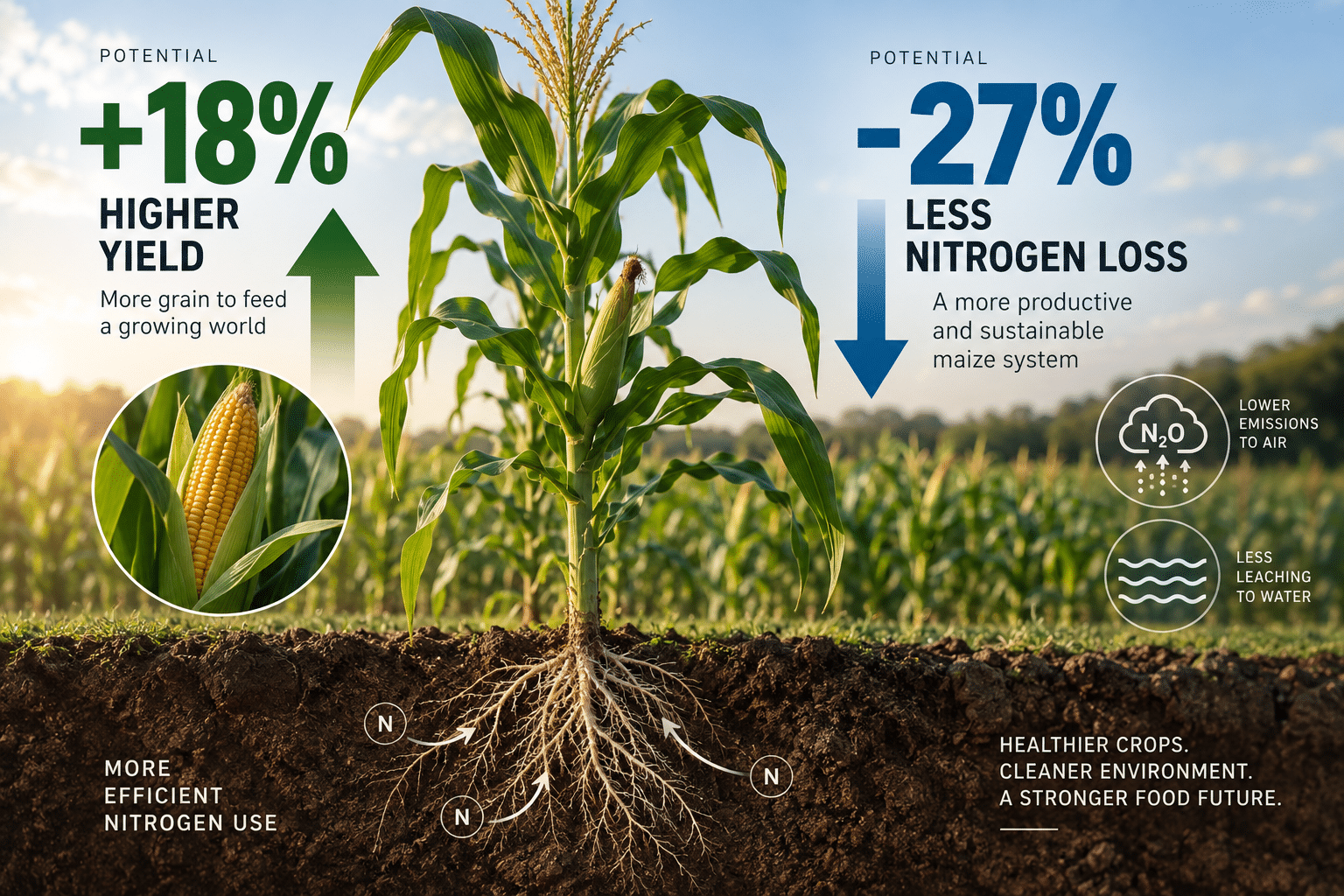
Under a full-adoption scenario, global maize yields could increase by 18.1 per cent, equivalent to an additional 145.78 teragrams of grain annually. Reactive nitrogen losses could fall by 26.6 per cent, or 1.49 teragrams per year.
The researchers described these figures as estimates of the upper biological potential. When adjusted to reflect current adoption levels in lower-efficiency regions, the near-term benchmark was approximately a 9 per cent yield increase and a 13 per cent reduction in reactive nitrogen losses.
Closing the Gap Between Breeding and Farm Adoption
The study identified several barriers preventing improved maize varieties from reaching their full potential. Researchers have yet to produce commercial varieties that consistently combine three or more G&E traits, while many experimental varieties have not entered commercial production in regions where their benefits could be greatest.
Varieties must also be paired with appropriate fertilizer use, planting density, pest management and market conditions to deliver their full value.
The researchers concluded that progress will require coordination across genetics, crop breeding, regulation, seed systems and farm management. Genomic selection, gene editing, synthetic biology and multi-environment field trials could help breeders combine beneficial traits, while policy and market support will be needed to make improved seed available to farmers in high-need regions.