Companies and research organizations are using AI to predict plant performance, target complex traits and speed breeding decisions, while academic teams test what could come next.
AI is moving deeper into crop breeding, from predicting which crosses are most likely to succeed to identifying genes behind complex traits and helping breeders match genetics to specific environments. A growing group of companies and research organizations is building platforms around those capabilities, with approaches that range from digital crop models and predictive genomics to AI-guided gene editing and automated marker analysis.
These eight organizations represent some of the players worth watching as those technologies move closer to practical breeding programs. At the same time, university researchers are testing new ways to combine AI, genomic prediction, crop modeling and automation — offering a glimpse at where AI-assisted breeding could head next.
Heritable Agriculture
Based in: California
Affiliation: Google spin-off
Among its services, Heritable Agriculture offers an AI breeding platform that simulates how existing varieties or crosses (breeding) will perform anywhere in the world to 10-meter resolution, speeding up breeding timelines. In addition to modeling on the whole plant level, the firm’s AI tech is identifying genes that control various plant functions.
Heritable Agriculture CEO Brad Zamft notes they are “filling the gap with our model, taking the performance data and integrating climate and soil data and then we make digital twins of crop plants. We can predict for breeders what crosses to do, what varieties to grow where and they use their experience and intuition to refine that.”
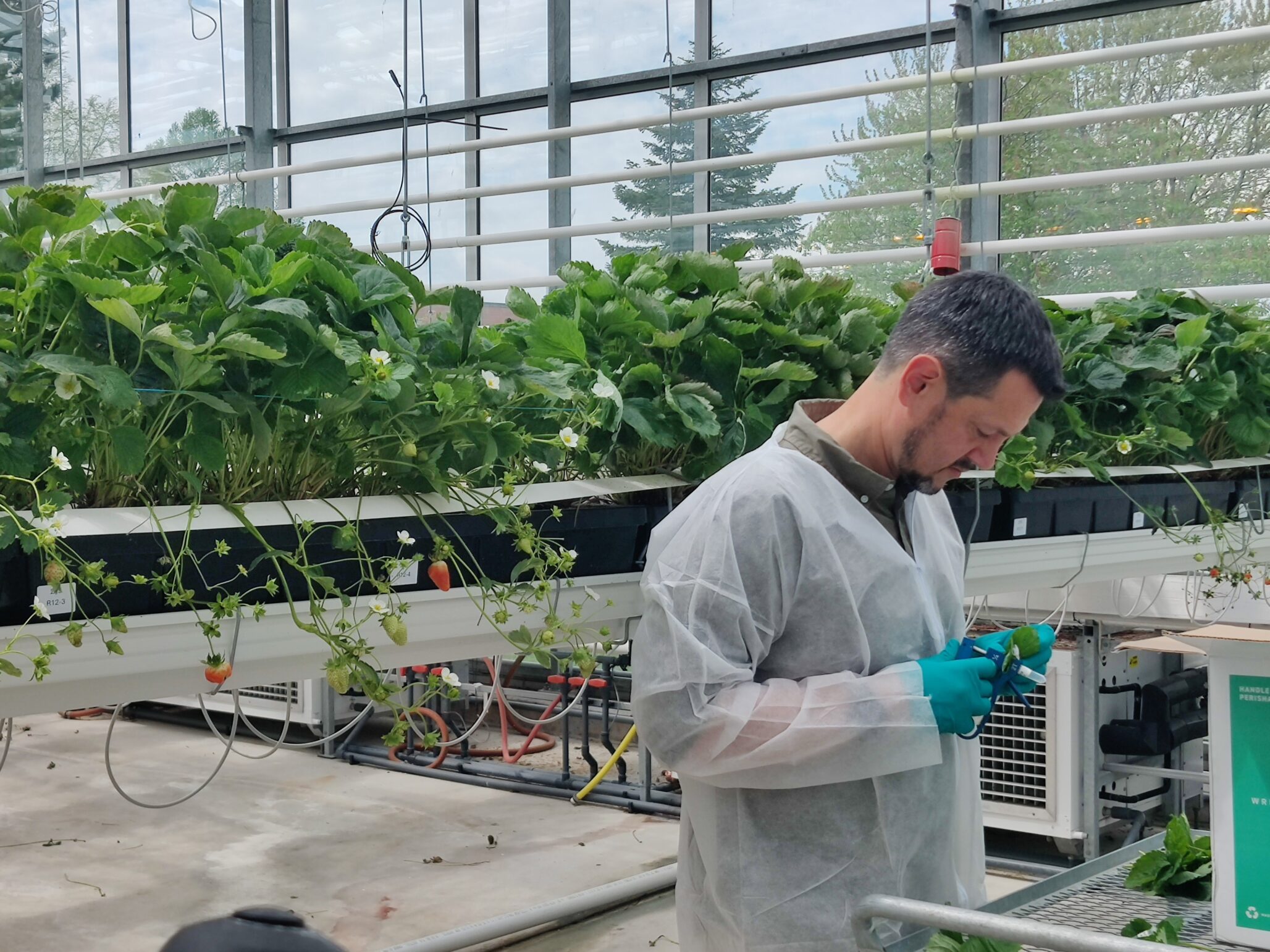
Heritable recently partnered with Paul J. Mastronardi (a greenhouse operator in Ontario, Canada) and Consorzio Italiano Vivaisti (a strawberry breeder in Italy). Traditional breeding programs have not addressed the needs of greenhouse cultivation, but the use of Heritable Agriculture’s platform will focus on maximizing taste, disease resistance, yield and other traits in the greenhouse environment. The new strawberry varieties are expected to reach market by 2028.
Rainbow Crops
Based in: Belgium
Affiliation: Spin-off of the VIB–UGent Center for Plant Systems Biology
Rainbow Crops offers a platform that uses systems biology and AI to identify the gene networks controlling complex traits and prioritize high-value genetic modifications. They then “create targeted genetic diversity through multiplex genome editing and precision breeding to explore complex trait architectures at scale” and “validate trait performance through phenotyping and biological measurement, generating data that continuously improves future predictions.”
Rainbow Crops is participating in a Gates Foundation-supported program to accelerate the development of improved maize, rice and sorghum. In June 2026, Rainbow Crops raised$11.25 million USD in a seed round led by LIFTT EuroInvest and other existing and new investors.
Plantik Biosciences
Based in: France
Rather than making changes to genes that encode protein, Plantik Biosciences targets the non-coding genes that regulate when and how rigorously a gene functions. Making changes to this ‘regulatory DNA’ enables plants to increase the strength of their response to heat, drought or disease, but permanent activation of stress responses (which can carry a yield or growth penalty) is avoided.
Plantik’s AI system uses multi-omic data to identify regulatory genetic switches and conduct edits using the chosen CRISPR approach, with an initial focus on tomatoes, corn and soybeans. The business model has a long-term focus on developing traits in-house and licensing them to seed companies, while making revenue in the near term by providing various services.
Plantik’s co-founders were named in the “Palmarès des inventeurs” at the Paris-Saclay Summit in February 2026.
Avalo
Based in: North Carolina
Avalo’s AI platform is able to identify the genetic basis of complex traits like drought or pest resistance, and also offers predictive modelling to predict plant performance and greatly speed up the breeding process.
“We’re currently working on improving cultivation efficiency in both cotton and sugarcane,” explains Co-founder and Chief Science Officer Mariano Alvarez. “In cotton, we’re focused on better matching ‘genetics to environment’ with a cotton program that creates high-quality cotton with zero added irrigation, 75% less fertilizer and 47% lower carbon footprint. In sugarcane, we are using AI to optimize cultivation in order to help farmers in Australia create more sugar with less resources.” Progress with a third crop will be announced in future.
Alvarez notes that “because the technology only informs decision-making (but doesn’t touch the actual breeding process), there is no fear of technology creating anything unnatural. This is the big difference between Avalo and solutions like GMO. Avalo is AI-informed but executed entirely by natural evolution.”
Velsera (formerly Ugentec)
Based in: Belgium and Cambridge, Massachusetts
Marker scoring after sequencing is one of the most time-consuming processes during genotyping. It is also a subjective process as there are often no discernable root cause for underperforming assays. The AI platform offered by Velsera solves this problem by automating assay scoring, reducing time to completion by up to 80%. It is customizable to meet client goals.
In January 2026, a team at the Swedish University of Agricultural Sciences noted in a paper titled ‘Breeding Smarter: Artificial Intelligence and Machine Learning Tools in Modern Breeding’ that “such software can be used for genotyping, pathogen testing at scale and quality control in industry, animal and seed health … it offers several benefits, including access to historical data repositories and the ability to apply intelligent algorithms tailored to specific assays, organisms, and workflows. By incorporating high-throughput phenotyping into machine-learning-driven genotype/phenotype models, breeders can not only enhance the pace at which they develop new cultivars but also work more efficiently in trait discovery. Together, reference genomes, causal gene discovery tools, and AI-enabled laboratory platforms form an integrated framework that accelerates trait discovery to improve breeding efficiency.”
Verinomics
Based in: New Haven, CT
Verinomics offers an AI-driven population genomics platform and predictive modelling that provides insights that optimize breeding decisions and also faster discovery of novel trait genes.
It has also developed a proprietary, transgene-free gene editing platform that enables precise product development with a focus on vegetatively propagated crops.
Crop Science Centre
Based in: Cambridge, UK
Affiliation: University of Cambridge
This organization combines AI, computer vision, and advanced data analytics with expertise in plant phenotyping, multi-omics, breeding and agronomy to enhance crop improvement in the UK and developing countries. The team works with companies like Bayer Crop Science, RAGT and Syngenta for commercial and academic research.
AI-CROPBREED
Based in: Europe
Affiliations: This project has received funding and support from sources such as the Scientific and Technological Research Council of Turkey, the ‘University of Agriculture in Krakow’ and the University of Agricultural Sciences and Veterinary Medicine of Bucharest.
This R&D platform ‘project’ provides AI-powered services to identify high-performing and climate-resilient plant varieties, and to manage data across breeding programs. This “enables breeders to visualize performance trends, compare genotypes, and collaborate through centralized dashboards.” They also offer an AI service that accelerates genetic marker discovery.
What Public Researchers Are Testing Next
Melanie Wilkinson and her University of Queensland, Australia colleagues are working on ‘Improved genomic prediction performance’, noting that traditional efforts in this area have focused on developing superior individual models. Instead, they have explored combining multiple genomic prediction models into an ensemble, based on the premise that the prediction error of the many-model ensemble should be less than the average error of the individual models due to the diversity of predictions included.
“The results show that the ensemble approach increased prediction accuracies and reduced prediction errors over individual genomic prediction models,” says the team, “suggesting the ensemble captures a more comprehensive view of the genomic architecture” of the two complex traits examined.
In July 2026, Binbin Dai and colleagues in China proposed the concept of ‘Click Breeding.’ They note that up until now, breeding for complex traits has been constrained by limited predictive accuracy and transferability, particularly varietal performance is greatly affected by non-additive genetic effects and genotype-by-environment interactions. They instead propose ‘Click Breeding,’ a paradigm that shifts emphasis from ranking individual candidates to generating and stress-testing entire multigenerational breeding programs.
They explain that this approach “connects genomic prediction, crop modeling and laboratory automation into a coherent, auditable design cycle that complements the breeder’s judgment.”
Another team in China introduces the ‘Breeding 5.0’ concept, which also enables predictive trait modeling, optimized parental design and targeted selection. It involves four areas, one being multimodal data integration that bridges genotype and phenotype, and another the use of modelling for virtual varietal performance testing.
The other two parameters are automated data capture to enable large-scale work, and finally, explainable recommendations going out to breeders.
“Together, these technologies algorithmically convert germplasm into actionable breeding insights, accelerating the full cycle from ideal plant type design to elite line development,” they note. “We further propose the ‘breeding flywheel,’ a self-reinforcing system that continuously amplifies phenotypic gains and refines breeding strategies, thereby enabling faster and smarter crop improvement to ensure a sustainable food future.”
A team from Canada notes that AI can assist breeding advancements in fine-tuning the parameters in the complex area of tissue culture. This can play a key role in better breeding decisions.
However, “automated AI-powered systems have further to be streamlined for monitoring and quality control, reducing human error and conserving resources.” This team also notes that AI tools have also helped overcome key challenges in the CRISPR/Cas gene editing system “by improving the accuracy of outcome predictions and reducing the need for extensive experimental optimization.”
In July 2026, the U.S. Department of Agriculture announced plans to launch an ‘Agricultural National Science and Technology Challenge’ by the end of 2026 to seek practical AI tools for better breeding, crop management and more, through the Genesis Mission and the Agriculture Advanced Research and Development Authority (AgARDA).