Texas A&M researchers are developing corn hybrids that tackle food safety, nutrition and resilience while delivering the yields farmers expect.
For decades, corn breeders have chased a familiar set of priorities. Higher yields. Better disease resistance. Stronger agronomic performance. Those priorities haven’t disappeared, but the list is growing.
At the National Association for Plant Breeding annual meeting, Texas A&M corn breeder Wenwei Xu shared research that illustrates how modern breeding programs are increasingly responding to requests to solve multiple challenges at once. His team’s work spans food safety, nutritional enhancement, climate resilience and commercial performance.
“We’re trying to minimize the bad compounds, the toxin or aflatoxin… The other trait we’re working on is increasing good compounds,” Xu said.
His breeding program focuses on reducing preharvest aflatoxin contamination while increasing anthocyanins and antioxidant content.
Aflatoxin, produced by the fungus Aspergillus flavus, is a worldwide problem that affects corn, peanuts, tree nuts and cotton. Because it is carcinogenic, federal regulations strictly limit acceptable levels in food and feed systems.
The challenge extends far beyond human health concerns. For farmers, contaminated grain can become an economic liability.
“When corn has high level of aflatoxin, farmers have difficulty selling that grain, so eventually it will go into the trash,” he says. “No elevator will take, so that’s important to develop aflatoxin resistant corn,” Xu said.
Building Resistance Through Multiple Traits
Rather than targeting a single aflatoxin gene, Xu’s team is breeding a package of traits that collectively reduce risk.
The program selects for drought tolerance, heat tolerance, insect resistance, tighter husk coverage and improved kernel quality.
The strategy recognizes that aflatoxin contamination develops through the interaction of the environment, the pathogen and the plant itself.
“Today there are two effective approaches: one is applying biological control to reduce the fungus in the field. As breeders, our goal is to improve the plant itself so it can better resist infection over time,” Xu says.
The work also reinforces a fundamental principle every seed company understands. Farmers still prioritize yield.
“The hybrid has to deliver high yields, otherwise farmers will not buy it and it will fail,” Xu says.
Looking Beyond Modern Germplasm
Xu’s team is also searching for new sources of resilience by expanding where they look for genetics.
The program incorporates tropical corn, teosinte and Tripsacum, wild relatives that have historically received less attention than elite commercial germplasm.
“There are more than 250 corn traditional, locally adapted varieties (known as landraces) stored in gene banks, but breeding programs typically rely on just two or three. That means a vast amount of genetic diversity — especially from tropical germplasm — remains largely untapped,” Xu said.
The work is painstaking. Researchers spend years crossing wild species into corn, then repeatedly backcrossing those traits into elite breeding material. Some early generations barely resemble modern corn at all.
Yet the effort may prove increasingly valuable as breeders search for new sources of insect resistance, heat tolerance and grain quality.
The team has also built a multi-state collaboration through the Southeast Regional Aflatoxin Test network, partnering with researchers in Texas, Mississippi, Georgia and North Carolina.
A New Category of Corn
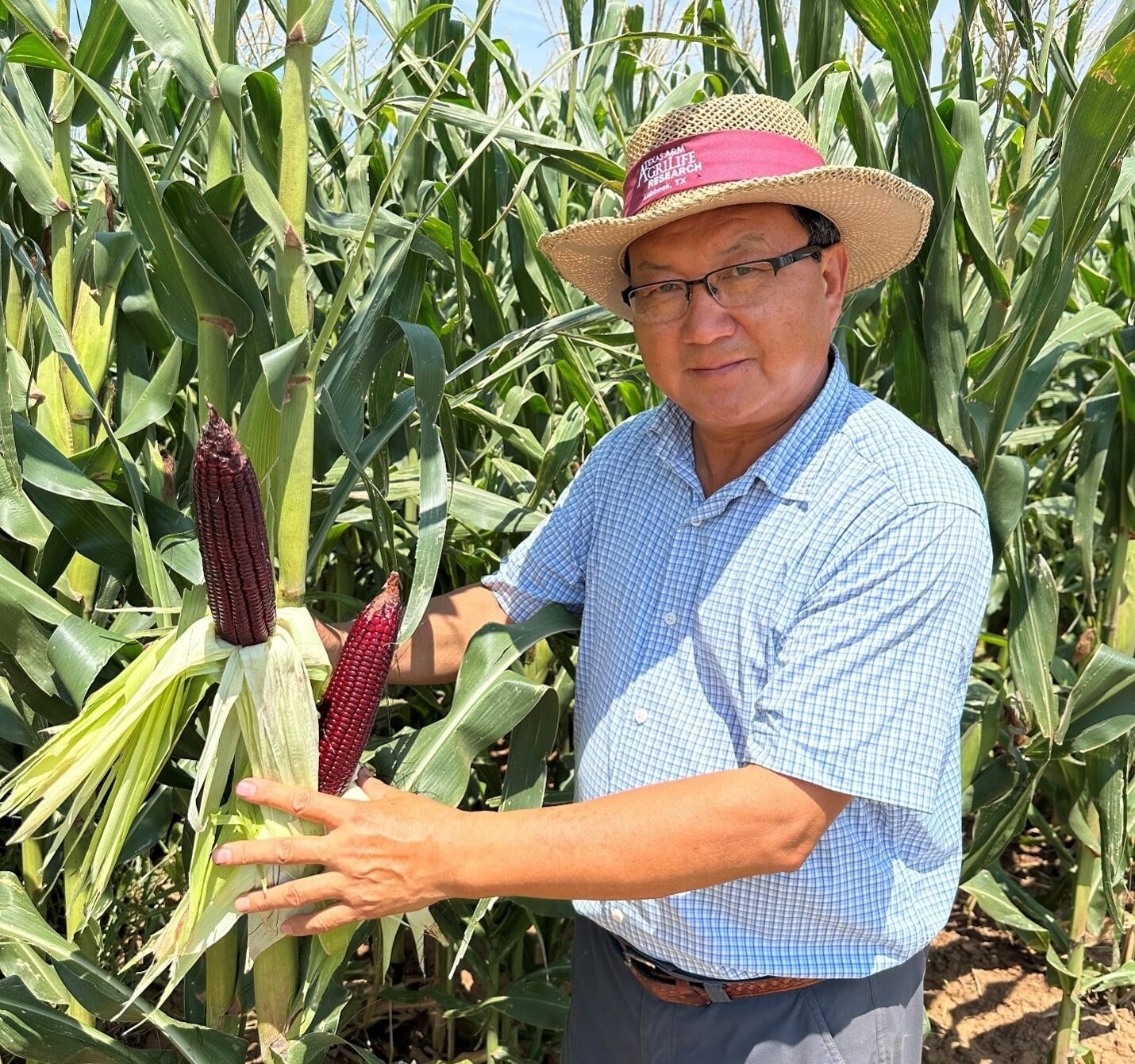
Xu focused on what he calls high-anthocyanin (Hi-A) corn, a real category of specialty corn bred to accumulate elevated levels of anthocyanins. The specialty hybrids accumulate high levels of anthocyanins and antioxidants in the cob, grain and other plant tissues.
Researchers envision applications ranging from fresh market products and tortillas to grain and silage systems. The work may also open new opportunities for livestock nutrition.
In one feeding study, researchers replaced a portion of bermudagrass hay with Hi-A corn cobs in lamb diets and maintained animal performance while improving some meat quality characteristics.
He said the team is also investigating potential human health benefits associated with antioxidant compounds absent from conventional yellow and white corn. Commercialization is already underway.
Xu shared that his team released its first hybrid in 2012 and introduced additional hybrids in 2020. Four more hybrids are expected in 2026. The products are now growing from California through Texas to Georgia.
The team is beginning to answer a larger question emerging throughout plant breeding. What if a corn hybrid could simultaneously deliver yield, food safety, nutritional value and resilience?
That possibility is moving from theory to reality. Xu said the challenge now is scaling it.