Supported by organizations like Bayer, the program connects top students with industry mentors — and is expanding opportunities for new partners.
The National Association for Plant Breeding (NAPB) Borlaug Scholarship program is gaining momentum, and as it looks ahead to 2026, new sponsors have an opportunity to help shape the next generation of plant breeders.
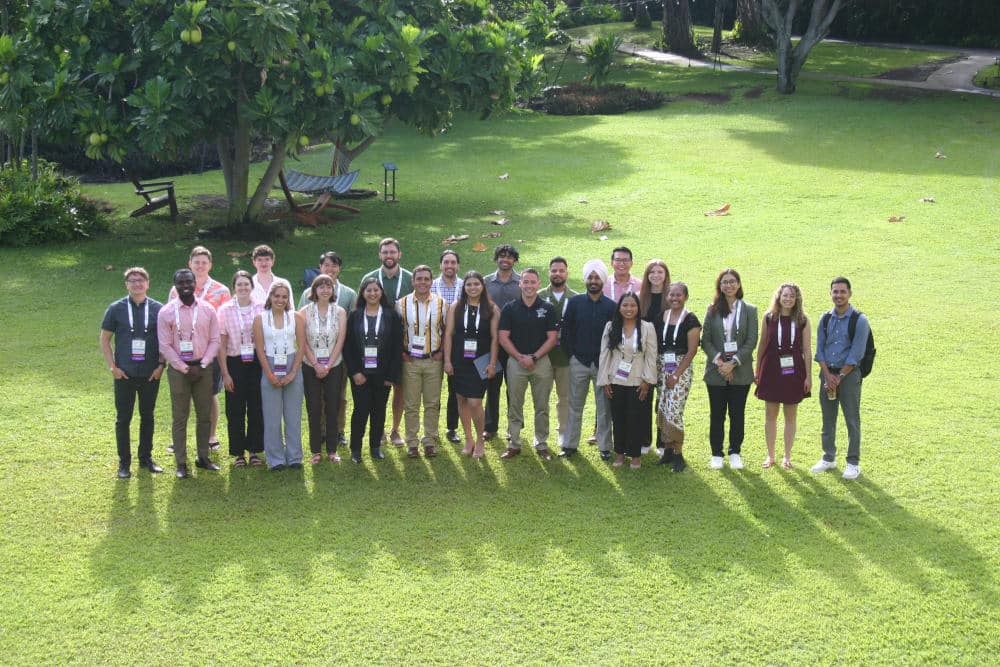
Last spring, 24 scholars were recognized at the NAPB meeting in Hawaii, marking another milestone for a program that has quickly evolved into one of the industry’s most impactful mentorship initiatives.
When corn breeding legend Donn Cummings launched the program in 2018, his goal was simple but ambitious: build a pipeline of talent by connecting students directly with leaders across academia and industry. Today, that vision is delivering measurable returns, not just for students, but for the future of agriculture.
“It’s not just symbolic,” Cummings said in remarks to attendees last spring in Hawaii.
“If you add it up, just one hour of mentoring a month over the course of the program, we’re talking about roughly 1,873 hours. If this were a consulting business, that’s about $225,000 worth of time invested.”
Backed by companies and organizations like Inari, Corteva, Bayer, and the American Seed Trade Association (ASTA), the program has already connected 156 mentors with students from 37 universities worldwide.
Now, with expansion underway — including growing international engagement — NAPB is actively seeking new partners to support the 2026 Borlaug Scholars cohort.
For sponsors, the program offers more than visibility. It provides direct engagement with emerging talent, early insight into the next generation of scientific leaders, and a meaningful role in strengthening the global plant breeding community.
Success Stories
Samuel Ipinyomi’s journey captures exactly what the Borlaug Scholarship makes possible, and why sponsor support is so critical. From a childhood shaped by the cultural importance of tomatoes in Nigerian cuisine to cutting-edge research on Fusarium wilt resistance, his story demonstrates how deeply personal experiences can fuel globally impactful science.
Scholar Karlene Negus represents the future of agriculture, where traditional farming knowledge meets the transformative power of artificial intelligence. Growing up on a corn and cattle farm, she understands firsthand the realities farmers face, and now, as a Borlaug Scholar, she’s applying advanced data science to predict how crops like corn and sorghum will perform in real-world conditions. Her work highlights the enormous, still-unrealized potential of AI to accelerate plant breeding and improve productivity at scale.
With the right support, scholars like these are not only advancing agricultural innovation, but also working on solutions that directly affect food security, farmer livelihoods, and resilient food systems. Sponsorship helps unlock this potential, enabling talented individuals from under-resourced regions to access training, mentorship, and research environments that would otherwise remain out of reach.
Scholarship Committee Chair Chandler Levinson of Bayer Crop Science notes that in a landmark move, six students from Africa are being sponsored to attend the 2026 NAPB meeting in Texas — and to take what they’ve learned back to the African Plant Breeding Association. Plans are underway to scale that globally.
Levinson, a commercial pepper breeder at Bayer, doesn’t just walk between rows of peppers and data spreadsheets — she walks between worlds. She’s helping usher in a new era where mentorship, not just machinery, defines the pace of innovation.
“We’re working on mechanical harvest in pepper,” she says. “But what’s exciting is that my design breeder, Natalie Kaiser, has mentored three students in the last three years through this work.”
At Bayer, innovation isn’t just a buzzword — it’s a unit. Entire teams are dedicated to breakthroughs, but Levinson’s lens is different. She sees mentorship as the fastest route to real impact. And that means not just training students to handle petabytes of breeding data — but to think, to listen, and, critically, to communicate.
“Your pipeline can live or die by data,” she says. “But data doesn’t build trust. Data can’t sit across from a farmer and ask what’s really keeping them up at night. I still visit every region every year to walk the plots and talk to farmers face-to-face.”
That tactile wisdom — of reading a plant, watching the soil, hearing a farmer’s hesitation in the wind — is the kind of knowledge you won’t find in a spreadsheet. And it’s what she’s trying to pass on to Borlaug Scholars, one conversation at a time.
For more info about how to come on as a sponsor, email chandler.levinson@bayer.com.