Scaling sustainable farming would prevent £150 billion hit to the economy by 2050, new report reveals.
A new report from the cross-party think tank Demos, supported by McCain Foods, finds that the UK food system is facing intense strain and urges the government to take swift action to help farmers transition to more sustainable practices.
Farmers are dealing with a wide range of pressures, including rising input costs, inconsistent profitability and an ongoing lack of policy certainty.
The report, The Sustainable Farming Dividend, argues that shifting to sustainable farming methods designed to deliver positive outcomes for land, nature and the environment, often described as regenerative farming, could make food production more resilient, help steady food prices and unlock billions in economic value across the UK’s £150 billion agri-food sector.
Key findings from the report include:
- Protecting the economy: Nature restoration through sustainable practices could unlock £56.3bn in natural capital by 2035.
- Boosting farm profitability: Adoption of sustainable methods could increase farm profits by £1.6bn a year by 2035, helping address a system where nearly one in five farms currently operate at a loss.
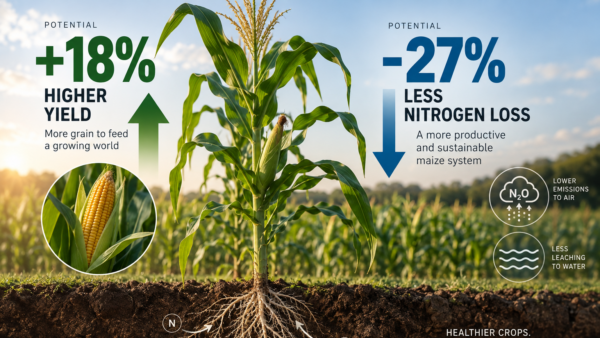
- Reducing reliance on volatile imports: With 60% of nitrogen fertiliser imported, sustainable methods could reduce total inputs by £905m annually and reduce fertiliser imports by £449m each year.
Despite these advantages, the report highlights a substantial gap in public awareness. However, when the connections between farming, climate impacts and food prices are clearly explained, public support for action increases significantly:
- 61% back greater government investment in sustainable farming.
- 45% say it should be prioritised over other spending areas.
- 31% would view the government more favourably if it increased investment
Taken together, these findings point to a growing public demand for leadership and a clear opportunity for action. With public backing for the transition increasing, the UK now has a genuine chance to drive a coordinated national response.
The report therefore urges the Government to build on current momentum to improve farm profitability by:
- Building strong partnerships: using the Farmer Collaboration Fund and upcoming Land Use Framework to scale up farmer clusters and develop regional Agri-Growth Hubs. This also includes partnering with local authorities and anchor institutions to convene farmers and investors, and embedding co-design models into the management of council-owned farmland.
- Supporting nature outcomes: developing standardised baselines for carbon, soil, water, and biodiversity.
- Plugging knowledge gaps: commissioning Skills England to review sustainable farming skills gaps and opportunities, and embedding an understanding of sustainable farming’s benefits.
Demos carried out the economic modelling between October 2025 and February 2026, with consumer polling taking place from 7 to 9 January 2026.
The analysis looks at how wider adoption of sustainable and regenerative farming could affect key economic and environmental outcomes in the UK. Most modelling assumes UK-wide adoption, while the food price analysis assumes global adoption because prices are largely set internationally.
For yields, profitability, import dependency and natural capital, the report compares current uptake of individual farming practices with their maximum potential over a transition period.