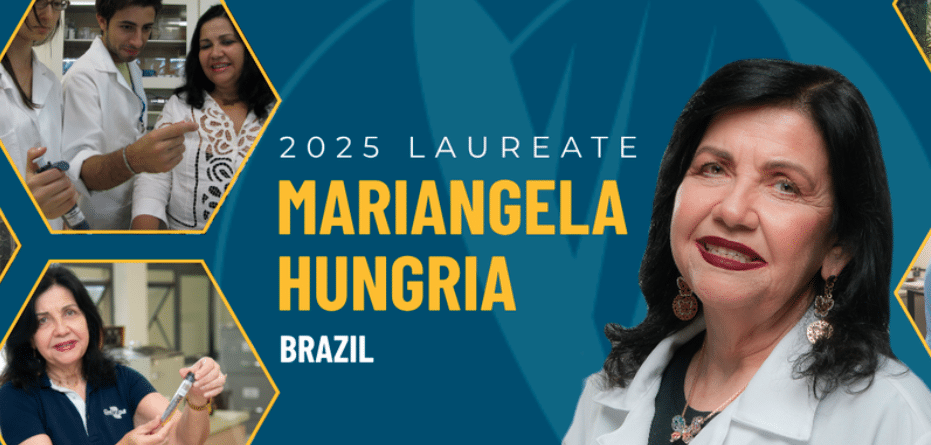
Embrapa researcher Mariangela Hungria has been named to the TIME100 2026 list in the “Pioneers” category, which honors 100 of the world’s most influential people. Published on Time magazine’s website, the list recognizes global figures for their impact, innovation, and achievements.
Hungria said she was deeply moved by the recognition and described the honor as something that still feels hard to believe.
“We are talking about recognition as one of the most influential people in the world,” she said in a press release. The researcher also pointed out how proud she is for representing Brazilian science in the international scenario. For her, the recognition is not only the result of her trajectory, but also of the work carried out at Embrapa, particularly in the field of biological inputs for agriculture.
“This is a great source of pride for Brazilian research, especially given such a relevant topic: the use of biological products to replace chemical ones,” she explained.
Hungria added that the recognition reflects a broader global shift toward valuing sustainable practices and the production of healthier foods.
“This shows that the world considers it important to produce food that promotes soil and people’s health, with less chemical residue, in line with the concept of One Health,” she says. She believes that visibility can further strengthen Brazil’s leading role in the sector. “In addition to the joy of receiving this recognition, it helps promote the cause of biological products, a field in which Brazil is already a world leader—and has the potential to become even more,” she concluded.
Who is Mariangela Hungria
Hungria is a Brazilian agricultural engineer, researcher, and professor internationally recognized for her work in biological inputs for agriculture. Born in São Paulo in 1958 and raised in Itapetinga, she developed an early interest in soil and plant microbiology, which led her to specialize in the field and become one of the world’s leading microbiologists. Since 1982, she has helped develop more than 30 technologies, published over 500 scientific and technical works, and supervised more than 200 students.
According to Hungria, global demand is rising not only for greater food production and better quality, but also for more sustainable farming systems that reduce soil and water pollution and lower greenhouse gas emissions. She argues that sustainable development must align with newer frameworks such as One Health, ESG, and regenerative agriculture. In practice, this means producing more with fewer resources, including less fertilizer, water, land, labor, and overall environmental impact.
Contributions to Agricultural Production
Hungria’s research has focused on increasing food production and improving crop quality by fully or partially replacing chemical fertilizers with microorganisms capable of biological nitrogen fixation, phytohormone synthesis, and the solubilization of phosphates and potassium-rich rocks. One of her major contributions was showing that, unlike findings reported in the United States, Australia, and Europe, annual soybean inoculation with Bradyrhizobium increases yields by an average of 8% in Brazil. Just as importantly, these gains can be achieved without nitrogen fertilizer, and farmers have adopted the practice on 85% of Brazil’s soybean acreage.
In 2014, she also introduced soybean co-inoculation, combining nitrogen-fixing bacteria (Bradyrhizobium) with the plant growth-promoting bacterium Azospirillum brasilense. In just over a decade, this practice has expanded to roughly 35% of the country’s soybean area.
In 2025 alone, the combined use of inoculation and co-inoculation in soybeans was projected to save $25 billion by avoiding nitrogen fertilizer use. Beyond the economic gains, these biological solutions helped prevent the release of more than 230 million tons of CO2 equivalent in 2024.
Beyond soybeans, Hungria has also led studies that supported the recommendation of rhizobia and co-inoculation for beans, as well as Azospirillum brasilense for corn, wheat, and Brachiaria pastures. In 2021, her team launched a technology that allows nitrogen fertilization in corn to be reduced by 25% through inoculation with A. brasilense, delivering both economic benefits to farmers and environmental gains for Brazil.