How climate change, gene editing, AI, regulation, public trust and new business models are changing the future of plant breeding in Europe.
Each year, the Seed World Europe Advisory Board comes together to provide guidance on the magazine and its editorial direction — what resonates, what is missing, and where greater focus is needed. As part of that discussion, one question returns consistently: what should we be paying attention to next?
At the most recent meeting, the Board challenged us to look beyond individual topics and take a more connected view of the future. What trends are emerging? How do they interact? What might we be overlooking? And how can the seed sector best prepare for what lies ahead?
At the same time, one theme stood out clearly: the pace of change in plant breeding and the seed sector is accelerating — and becoming harder to interpret.
Climate change is no longer a distant risk, but a daily reality shaping breeding priorities. New breeding technologies are advancing rapidly, from gene editing to artificial intelligence. At the same time, regulation, public perception and geopolitical tensions are redefining what is possible, not just what is technically feasible.
And perhaps most importantly: all of these developments are happening at the same time. The question is no longer simply what is changing? It is: how do these changes interact — and what do they mean for the future of the seed sector?
From Trends to Trajectories
The Advisory Board challenged us to go beyond isolated topics. Yes, climate adaptation matters. Yes, AI will reshape breeding. Yes, regulatory frameworks are evolving. But looking at each of these developments in isolation risks missing the bigger picture.
What is needed is a way to connect the dots. Which trends reinforce each other? Which create tension? Where are the blind spots? And what capabilities will seed companies need to navigate what lies ahead?
A Series to Explore What Comes Next
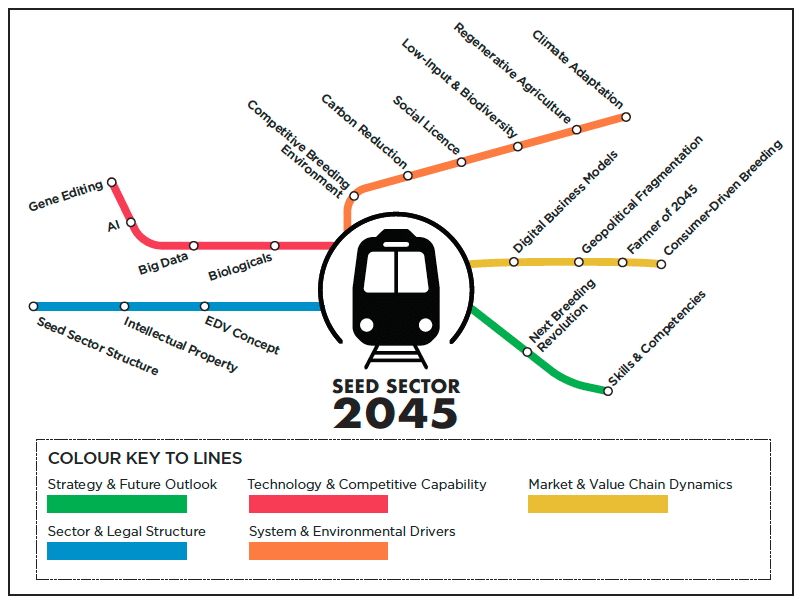
This question forms the basis of a new Seed World Europe editorial series: Seed Sector 2045. The accompanying metro map visualises this journey, with each station representing one trend and all lines leading towards the same destination: the seed sector of 2045.
Over the coming months, we will publish a series of one-page articles exploring the structural trends shaping plant breeding and the seed sector over the next 10 to 20 years. Each article focuses on a single topic — from climate adaptation and regenerative agriculture to gene editing, intellectual property, digital business models and the future role of the farmer.
Some of these themes are already visible. Others are only just emerging. All of them are interconnected. Together, they form a map of the future — a journey made up of interconnected “stations”, each representing a key development shaping the seed sector of 2045.
Europe’s Future in a Global Context
While many of these trends are global, their impact is not uniform.
In Europe, the sector operates within a unique context shaped by regulatory frameworks, societal expectations and environmental ambitions. Questions around public trust, biodiversity, water quality and input reduction are not peripheral — they are central.
This raises important questions: Is Europe still a competitive breeding environment? How can innovation and regulation move forward together? And how can the sector maintain its social licence to operate?
Preparing for What Lies Ahead
The aim of this series is not to predict the future with certainty. It is to help the sector prepare for it.
What will define successful seed companies in 2045? Which investments are needed today? What skills will be required? And how will the relationship between breeders, farmers, consumers and policymakers evolve? These are not abstract questions. They are strategic ones.
Because while the goal of plant breeding remains unchanged — delivering genetic gain — the environment in which that goal must be achieved is changing fundamentally.
A Shared Journey
We invite readers to follow the series, challenge its assumptions and contribute to the discussion. The future of the seed sector will not be shaped by one trend, technology or decision. It will be shaped by how well we understand, and act on, the connections between them.
Seed Sector 2045: The Road Ahead
A 20-part series exploring the trends shaping plant breeding and the seed sector over the next two decades.
System & Environmental Drivers
- Climate Adaptation
- Regenerative Agriculture
- Low-Input & Biodiversity Systems
- Social Licence & Policy
- Carbon in the Food Chain
- Europe’s Breeding Competitiveness
Seed Sector & Legal Structure
- Seed Sector Structure 2045
- Multi-Layer IP
- EDV Future
Technology & Competitive Capability
- Gene Editing (NGTs)
- AI Breeding
- Big Data Infrastructure
- Biological Integration
Market & Value Chain Dynamics
- Consumer Demand
- Farmer of 2045
- Seed Trade & SPS
- Digital Business Models
Strategic Reflection
- Funding the Breeding Revolution
- Future Skills
Final Destination
- Connecting the Dots – The Pathway to the Seed Sector 2045
Read Article 1: The Seed Sector 2045: Climate Adaptation Becomes Breeding’s New Baseline
Read Article 2: Seed Sector 2045: How Low-Input Farming Is Changing Plant Breeding
Read Article 3: Seed Sector 2045: Cover Crops Offer Regenerative Opportunity for Seed
Read Article 4: Seed Sector 2045: Why Public Trust Matters for Plant Breeding Innovation
Read Article 5: Seed Sector 2045: Is Europe Competitive for Plant Breeding Innovation?
Read Article 6: Seed Sector 2045: The Future Seed Sector May Be More Layered Than Larger
Read Article 7: Seed Sector 2045: Why Plant Breeding IP Matters for Europe’s Future
Read Article 8: Seed Sector 2045: Why NGTs Make the EDV Question More Important Than Ever