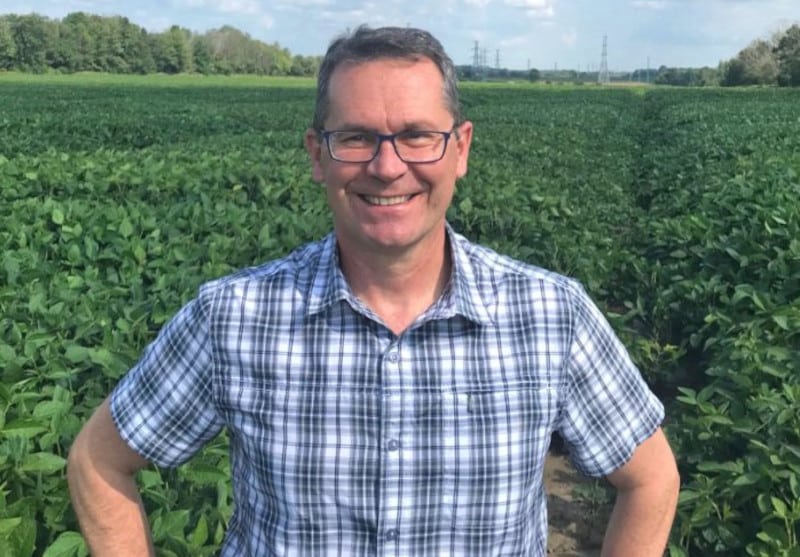
National Association for Plant Breeding (NAPB) 2025 Public Sector Impact Award recipient Istvan Rajcan measures success in many ways. He mentions farmer adoption, industry partnerships and the scientists he prepares to lead the next generation of soybean breeding.
When Istvan Rajcan talks about impact, he doesn’t begin with awards. He doesn’t even begin with the 87 soybean varieties his program has developed since 1998. He begins with farmers.
“The real measure of success of a variety is whether the farmers grow it or not,” says Rajcan, professor in the Department of Plant Agriculture at the University of Guelph and recipient of NAPB’s 2025 Public Sector Impact Award.
Farmers Cast the Deciding Vote
Some varieties become popular and remain in production for years. Others quietly disappear. That’s simply part of the process, he says.
For Rajcan, the reward comes from knowing farmers continue choosing something his program developed.
“Hearing from farmers when they are happy about the varieties they grow out of our program gives me satisfaction that we are doing something for agriculture and for the farming community,” he says.
Funding Model Built on Partnership
That farmer-centered perspective has defined much of Rajcan’s career, but it has also been supported by a unique Canadian funding structure that he believes offers valuable lessons.
His breeding program has the ability to partner with private seed companies and then leverage those investments through matching provincial and federal government programs.
“When we get funding from private industry partners, we can access matching programs from provincial or federal governments, sometimes one to one and sometimes two to one,” he says.
The approach creates opportunities to build stronger breeding programs while ensuring research remains connected to industry needs.
Freedom to Follow the Science
Still, when asked about public plant breeding’s biggest competitive advantage over the private sector, Rajcan didn’t mention funding.
“I would say freedom to operate,” he says.
That freedom allows him to collaborate with multiple companies, explore a wider range of research questions and shift priorities as agriculture evolves.
“We’re not profit driven per se, so we can choose the projects, the traits and the topics for research freely.”
Yet even after a career spent developing soybean varieties and advancing Canadian agriculture, Rajcan says his proudest accomplishment isn’t found in a field.
“To me, what’s more important is the graduate students that I’ve trained,” he says. “That’s why I came from private industry into academia, because I love to teach students and help them grow.”
Watching young scientists gain confidence has become one of the most rewarding parts of his career.
“To see them go from timid, insecure young people to successful, confident scientists, that makes my day,” he says.
Impact isn’t just about genetics, acreage or publications. It’s about building systems that support innovation, creating partnerships that strengthen agriculture and preparing future scientists to carry the work forward.
Long after individual varieties disappear from production, those investments in people will remain.