New conversations about seed policy, concerns over declining agricultural R&D investment, and recognition for two of Canada’s most influential plant breeders all point to the same truth: innovation is built through long-term commitment, not short-term thinking.
This week, a series of stories landed in our newsroom that, on the surface, seem unrelated.

One is about seed policy. Another is about two plant breeders receiving some of the highest honours Canadian agriculture can bestow. Another examines the worrying state of Canada’s agricultural R&D investment. And another looks at the global seed testing community preparing to gather in Calgary next week.
But together, they tell a single story. It’s a story about what it actually takes to build an innovation economy.
For years, Canada’s agriculture sector has talked about innovation as though it’s something that simply appears when conditions are right. Invest in a few programs, launch a strategy, create a working group. Innovation follows, right? Reality is far messier.
Innovation is the result of systems. It emerges when policy, people, science, investment and infrastructure all move in the same direction. This week offered a reminder of both how far we’ve come, and how much work remains.
The federal government’s latest signals around innovation and seed policy suggest that Canada is beginning to understand what global competitors learned years ago: innovation needs incentives. Strong intellectual property frameworks, predictable regulatory pathways and a business environment that encourages investment aren’t luxuries. They’re prerequisites. That’s encouraging.
But policy alone doesn’t create new varieties. People do. Look at Brian Rossnagel.
For decades, Rossnagel transformed barley and oat breeding in Canada, helping deliver varieties that improved productivity, quality and competitiveness across the value chain. His induction into the Canadian Agricultural Hall of Fame is well deserved. Yet it’s also a reminder that the benefits we enjoy today often trace back to breeding decisions made decades ago.
The same can be said for Dr. Weikai Yan. His career demonstrates what happens when scientific excellence is sustained over a lifetime. His work has shaped how breeders around the world understand genotype-by-environment interactions, while his practical breeding contributions have improved crops grown by farmers every day.
Neither Rossnagel nor Yan became leaders because they operated within a perfectly designed innovation system. They succeeded despite many of the challenges that continue to frustrate researchers today. And that should concern us, because while we celebrate their achievements, the evidence continues to mount that Canada’s agricultural R&D engine is under pressure.
The latest episode of On The Brink examines a reality many industry leaders have been discussing quietly for years: Canada is losing ground on agricultural research investment relative to key competitors. The consequences aren’t immediate. Agricultural innovation doesn’t work that way. The danger is that the impacts show up 10, 15 or 20 years from now. The variety that never gets developed, the company that chooses to invest elsewhere, the researcher who leaves. The opportunity that quietly moves to another country.
Agricultural innovation is one of the longest games society plays. The investments made today determine productivity, sustainability and competitiveness decades into the future. That’s why short-term thinking can be so costly. Which brings me to Calgary.
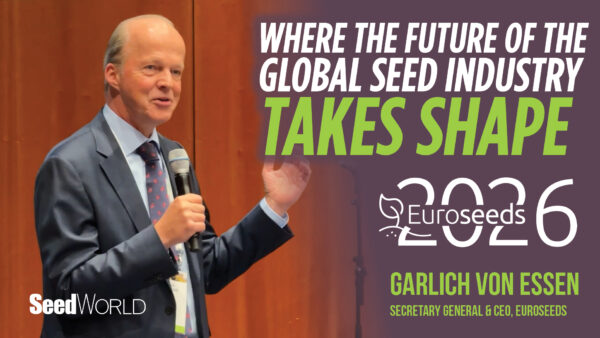
Next week, the global seed testing community gathers for ISTA 2026. Experts from around the world will discuss seed quality, testing standards, market access and the systems that enable international seed movement. Canada will be on display as a host nation for one of the seed sector’s most important global gatherings.
Events like this remind us that innovation isn’t only about discovery. It’s also about trust. A new variety has little value if markets can’t access it. A breeding breakthrough means little if quality systems fail. Scientific advances require institutions, standards and infrastructure that allow innovation to move from the lab to the farm and ultimately to the marketplace.
That’s the thread connecting every one of this week’s stories. Policy matters. So do scientists, investment, and infrastructure. The countries that lead in agricultural innovation understand that all four must work together.
Canada has extraordinary assets, world-class breeders, and globally respected researchers. We have strong public institutions and a reputation for scientific excellence. We are seeing renewed conversations about regulatory modernization and innovation policy. But celebrating our strengths shouldn’t make us complacent.
The question isn’t whether Canada can be an agricultural innovation leader. The question is whether we’re willing to build the conditions necessary to remain one.