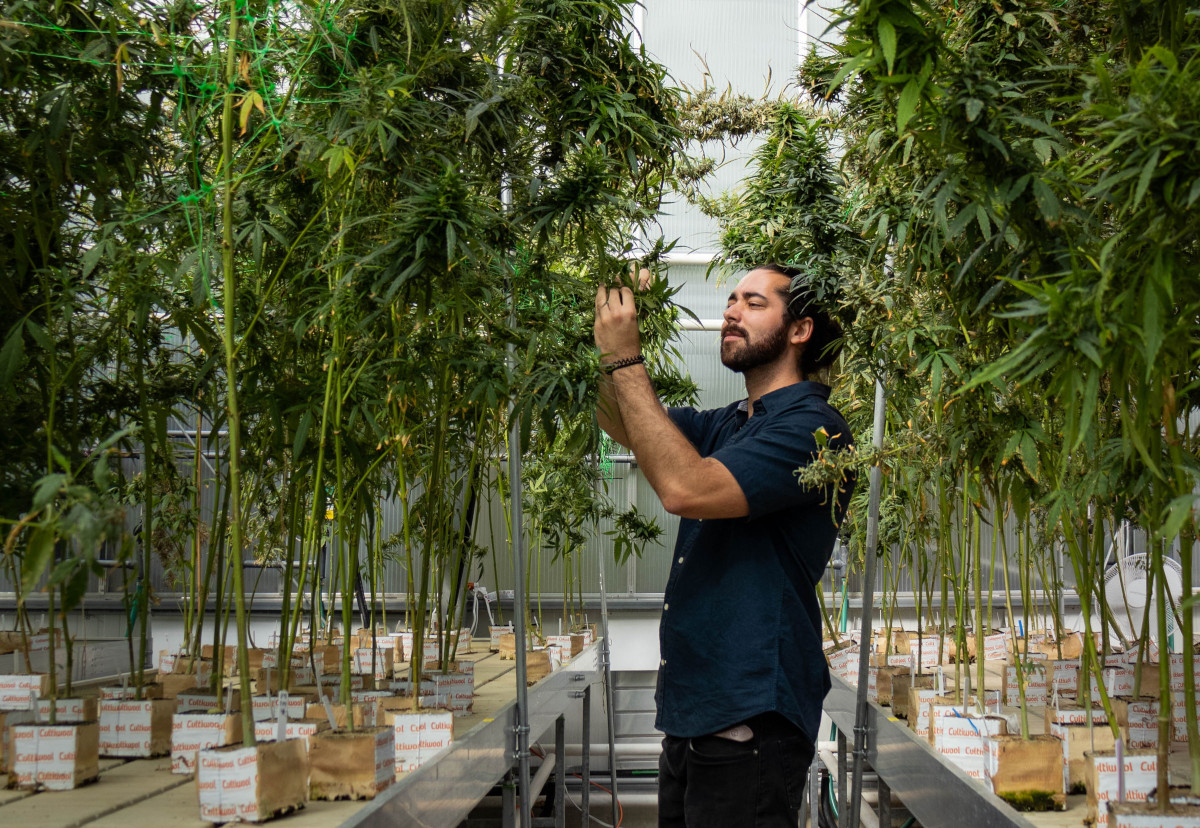
University of British Columbia PhD student Vincent Fetterley is developing genomic and computer vision tools to help breeders improve hemp faster, demonstrating how AI and plant breeding are transforming Canada’s emerging crop sectors.
When Vincent Fetterley first saw it happen in the field, the science stopped being theoretical.
He had crossed two wheat plants himself — one resistant to stripe rust, the other vulnerable. Months later, standing among rows of infected wheat covered in yellow disease streaks, he could suddenly see genetics playing out in real time.
“There was this really clear segregation,” he recalls. “Three resistant plants for every susceptible one.”
For Fetterley, it was the moment plant breeding transformed from an academic discipline into something closer to engineering biology.
“That’s when it clicked,” he says. “You can actually build plants with the traits you want.”
Now, the University of British Columbia PhD student is being recognized with a Canadian Plant Breeding Innovation (CPBI) Scholarship for research that could help modernize one of agriculture’s most misunderstood crops: hemp. He’s the second of three students to be profiled, the first of which was profiled last week.
His PhD research at UBC’s Michael Smith Laboratories focuses on hemp genomics, flowering time genetics, fibre quality, and high-throughput phenotyping — essentially building the tools breeders need to accelerate hemp improvement at scale.
One of his most ambitious projects involves developing a computer-vision pipeline capable of rapidly analyzing hemp stem anatomy and fibre characteristics from images — a low-cost, high-throughput alternative to slower traditional fibre analysis techniques.
It is the kind of work increasingly reshaping agriculture: combining biology with automation, imaging, and machine learning to make breeding dramatically faster and more precise.
His supervisor, Marco Todesco, says Fetterley has already identified multiple genetic loci controlling flowering time in hemp during the first years of his PhD.
More importantly, Todesco says, Fetterley understands the broader vision behind the science.
Fetterley believes agriculture is entering an era where advances once reserved for major commodity crops will become accessible to smaller, historically overlooked crops through cheaper sequencing technologies, AI, and shared global datasets.
In practical terms, that could mean global genomic databases, shared diversity panels, and open-access breeding tools for crops previously considered too niche to justify major investment.
Colleagues say Fetterley is particularly well-suited to that transition because of the speed at which he absorbs new information.
University of Alberta wheat breeder Gurcharn Singh Brar describes him as having an “insatiable appetite for science.” He recalls Fetterley reading an entire classical rust genetics textbook within two weeks early in his master’s program and returning with pages of research ideas and questions.
Fetterley himself attributes much of his learning not to working alone, but to aggressively seeking out people smarter than he is.
“Science is too broad now for anyone to be an expert in everything,” he says. “A huge part of learning is networking, talking to people who know more than you, and using those conversations to identify knowledge gaps.”
That collaborative mindset may be exactly what agriculture needs next.
As climate pressures intensify and global food systems search for lower-input, multi-purpose crops, hemp is attracting renewed attention. But realizing its potential will require an entirely new generation of breeders — scientists capable of moving seamlessly between greenhouses, genomic datasets, AI tools, and field trials.
Researchers like Vincent Fetterley are already building that future.
The Canadian Plant Breeding Innovation Scholarship is made possible by Alberta Grains, the Canadian Seed Growers’ Association, FP Genetics, HyTech Production, Richardson, SaskWheat Development Commission, SeCan, Seeds Canada, Seed World Canada, and Warburtons.