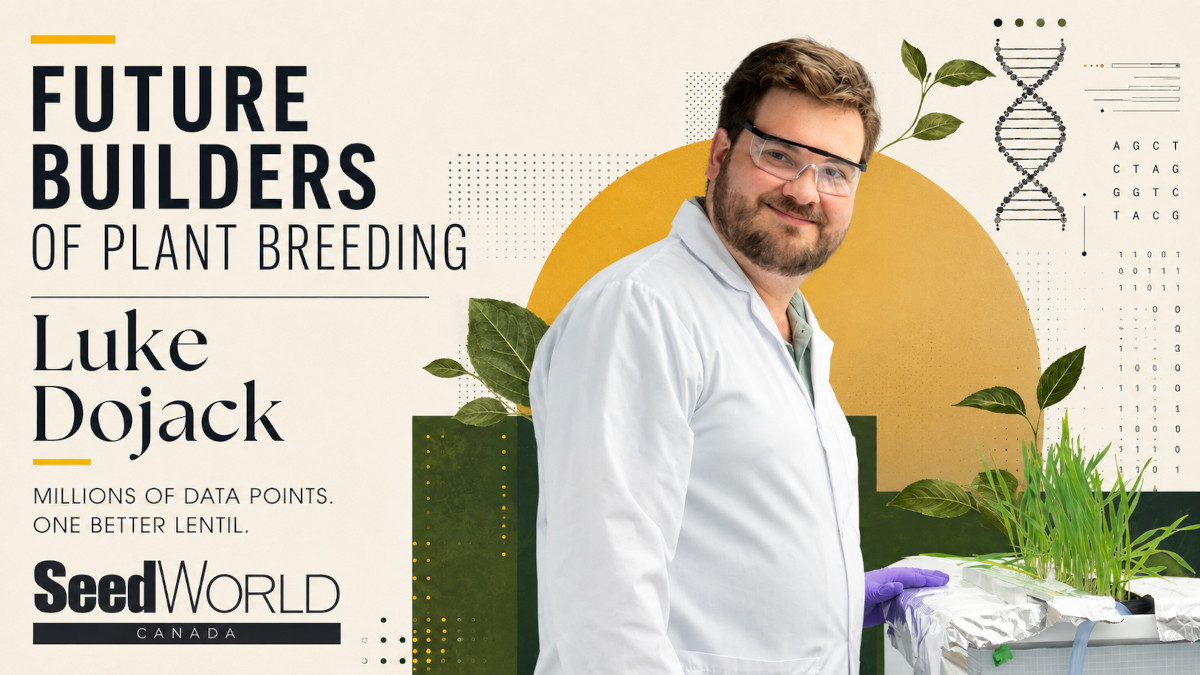
A University of Saskatchewan PhD student is combining field experience, genetics and AI to build faster, more practical tools for lentil breeding.
Luke Dojack still remembers when plant breeding first captured his imagination.
In middle school, he encountered a passage in Les Misérables describing a man whose hobby was crossing plums. Inspired, he began crossing morning glories in his backyard for different flower colours, sparking a fascination with plant genetics that eventually became a career.
Today, as a PhD student in at the University of Saskatchewan, Luke is building digital tools that could make traditional breeding faster and more precise.
His research focuses on digital phenotyping in lentils, combining UAV imagery, computer vision, soil sensors, root imaging, microbiome data and artificial intelligence to predict nitrogen-fixation traits that are difficult and time-consuming to measure conventionally.
“I want to use every available tool,” he says, including GWAS, UAV and 2D imaging, field observations, soil electrical conductivity, beneficial microbes and AI. His goal is to identify genetic markers associated with residual nitrogen while developing cost-effective methods other breeding programs can adopt.
Yet his experience begins in the field. At Paterson Grain, he helped manage small-plot research trials, collected harvest data and mentored summer students.
That background gives him something algorithms can’t: an understanding that every data point ultimately represents a real field and a real farming decision.
University of Saskatchewan professor Tom Warkentin describes him as tackling “an innovative and challenging PhD research project” and highlights his combination of academic excellence, agricultural experience and leadership.
That combination may define the next generation of plant breeders. Understanding genetics will remain essential, but so will mastering data, automation and artificial intelligence — and turning millions of observations into better breeding decisions.