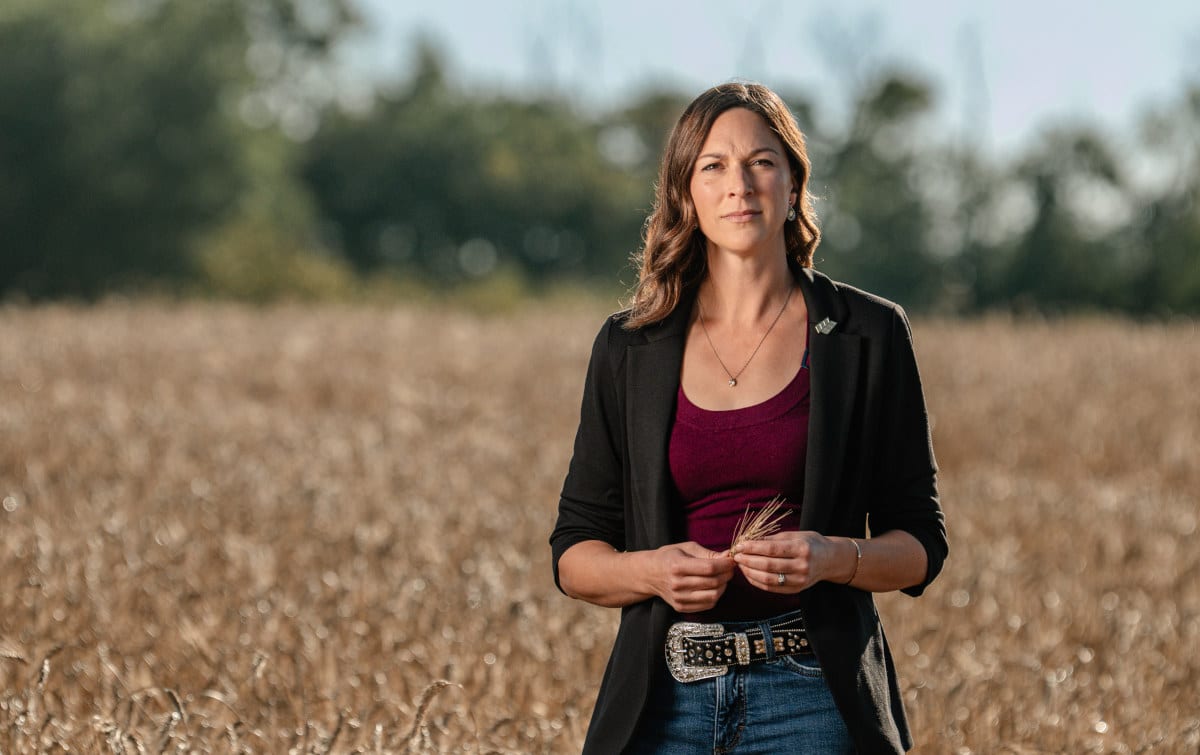
With Canada’s wheat research system facing major changes, Canadian Wheat Research Coalition Chair Jocelyn Velestuk says farmers must do more than fund breeding programs. They need to help shape the system that delivers tomorrow’s varieties.
Jocelyn Velestuk knows farmers are natural systems thinkers. They have to be. Every season requires them to understand enough about agronomy, weather, machinery, markets and finance to make decisions that eventually meet in the same places: the bin and the balance sheet.
“We have to know enough about everything in order to make those decisions,” says Velestuk, a Saskatchewan farmer and chair of the Canadian Wheat Research Coalition (CWRC) and chair of Sask Wheat Development Commission (Sask Wheat).
Now farmers are being asked to apply that thinking to something much larger: the future of Canada’s wheat breeding system.
It represents a significant shift in responsibility. Producers have long helped finance wheat research through their checkoffs. They have identified priorities, served on research committees and grown the resulting varieties. As changes to the federal research capacity creates questions about how the breeding system will function in the future, Velestuk is providing the important producer perspective to help farmers move from funding individual breeding programs to shaping how the entire system functions.
The question is no longer simply which research projects farmers should support. It is whether the people, plots, testing systems and seed multiplication capacity needed to carry an idea from the laboratory to a commercial field will still be connected 10 or 15 years from now.
For Velestuk, farmers cannot remain observers in that discussion.
“We need to keep that pipeline full,” she says. “We need to keep those varieties coming. We need to keep plant breeders working with a long-term vision, and we need to keep them connected to the latest technologies.”
A Farmer Who Learned the System
Velestuk grew up on a first-generation family farm between Wishart and Wynyard, Sask. Her parents built up the operation and she remembers the time being difficult for farm profitability due to low priced commodities and not a lot of risk management tools being available.
She pursued a career away from farming before she and her husband decided to return to agriculture. It was not the safe choice.
“Farmers make hard decisions every day,” she says. “We choose to go into a business with really high risk. But there is also the opportunity to build and grow and to have some agency over the decisions we make.”
On their farm near Broadview, Velestuk focuses heavily on the business side. That work taught her to see research not as an abstract public good but as part of the farm’s risk-management strategy.
Her involvement with Sask Wheat’s research committee for more than six years brought her into conversations with breeders and scientists. She learned how long variety development takes, how many people contribute and how easily an apparently small loss of capacity can affect the entire process.
She also saw a disconnect. Farmers were investing heavily in breeding, but many did not have a clear picture of how the system worked, where its weaknesses were or what their money ultimately secured.
Since 2020, the CWRC has invested $70.5 million in Agriculture and Agri-Food Canada (AAFC) and university wheat breeding programs. Its current agreements include $19.9 million for AAFC breeding from 2025 to 2028 and $16 million for university programs.
With that level of investment, Velestuk argues, farmers should help determine the system’s direction.
“Farmers were asking questions,” she says. “We wanted more information, and we weren’t getting it. Now we are getting the information we’ve been asking for.”
Success Can Conceal Risk
The immediate difficulty is that Canadian wheat breeding still appears highly successful.
The CWRC’s review found that AAFC varieties are planted on roughly 80% of Canadian wheat acres in an average year. In 2025, the four leading Canada Western Red Spring varieties were developed through AAFC’s Swift Current Research and Development Centre program.
“If you’re a farmer and you don’t know the background, you might say, ‘What’s the problem here?’” Velestuk says. “We’re growing some of the best varieties we’ve ever grown.”
The problem is the delay between investment and impact. Today’s leading wheat varieties began as crosses made between 2001 and 2009. The average journey from an initial cross to commercial release is 13 years. A cross made today may not reach the marketplace until 2037.
Farmers are benefiting from research capacity assembled more than a decade ago. Reductions made now may not become fully visible until the varieties needed to confront a future disease, climate or market challenge fail to arrive.
Velestuk points to AAC Brandon as an example of what a connected system can deliver.
“If we didn’t have Brandon come out when it did, I don’t know where our industry would be,” she says.
When Seed World interviewed wheat breeder Ron DePauw after AAC Brandon was named Seed of the Year in 2019, he credited producer checkoffs, strong farmer engagement and a stable team of scientists and technicians.
“AAC Brandon was very much a team effort,” DePauw said. “It wasn’t just me.”
That is precisely Velestuk’s point. Canada cannot assume another transformative variety will just emerge. It has to maintain the system capable of producing one.
Farmers Need More Than Genetics
The CWRC examined five connected stages: foundational science, germplasm enhancement, variety development, pre-market evaluation and commercialization.
Its review identified the most serious vulnerabilities in variety development and pre-market testing — the stages where promising genetics are turned into field-ready varieties and tested against regional conditions.
Velestuk is particularly concerned about disease nurseries, where researchers deliberately expose plants to enough pressure to distinguish meaningful resistance from good fortune.
Dana Maxwell, chair of the Prairie Recommending Committee for Wheat, Rye and Triticale, says that kind of testing produces information farmers may not realize they use.
Discussions are ongoing about a proposal to move rye, triticale, flax, peas, lentils and faba beans from Part I to Part III of the federal variety registration system. The change would remove the requirement for recommending committees to assess merit before registration.
It would not prohibit testing. But Maxwell says the value chain must establish who would generate the information currently produced through registration trials.
For fall rye, Western Canadian protocols require 15 site-years of testing over three years. Those years increase the chance that a variety will encounter winter conditions capable of revealing where it can survive. While the data set is not exhaustive and cannot capture all conditions, it reduces the risk of a variety with poor winter survival reaching market.
“If it doesn’t survive, there’s no point in having it,” Maxwell says. “Or if it only survives in certain areas, now we know, and you can commercialize it where it fits.”
The resulting data can feed seed guides, inform commercialization and give farmers an independent basis for comparing varieties.
Maxwell is open to changing the process where change makes a positive impact for all value chain members, particularly primary producers. Her concern is that its functions be understood and replaced deliberately rather than lost unintentionally. That distinction fits Velestuk’s approach. Farmer leadership does not mean resisting change. It means asking what farmers need both before and in future years once the change is made.
The Bridge to the Seed Grower
The same principle applies at the other end of the system.
David Gehl spent 25 years heading AAFC’s Seed Increase Unit at the Indian Head Research Farm, Sask. With discussions underway about continuity of agricultural activities at the site, he warns that its role cannot be reduced to buildings and equipment.
The unit receives small quantities of pre-breeder seed from AAFC scientists and multiplies them under strict quality controls. The resulting breeder seed goes to Select growers, beginning the multiplication process that eventually makes certified seed available to farmers.
Gehl calls the unit “a bridge between plant breeders and commercial pedigreed seed growers.”
Using the 2026 Saskatchewan seed guide, he estimates that AAFC varieties produced as breeder seed through Indian Head account for close to 20 million acres of insured commercial production across the Prairies and British Columbia.
The site has productive Class 1 soils, carefully managed rotations, a specialized seed plant, pathogen-control equipment and cold storage. But Gehl says the people matter just as much.
“Physical facilities are only half of the recipe for successful breeder seed production,” he writes. “The other critical component is the team producing the seed.”
The staff need expertise in breeding, agronomy, pathology, conditioning and pedigreed seed production. One mistake can destroy a year’s multiplication and delay a variety’s arrival on farms.
Gehl’s warning reinforces Velestuk’s central argument: funding breeders is not enough if the bridges carrying their work to farmers are allowed to weaken.
From Investment to Responsibility
In February, the CWRC declared that “status quo is not an option.” The conclusion followed a review of 27 reports and research papers, interviews with 29 stakeholders and two facilitated workshops.
Velestuk says the CWRC board spent two days examining the findings before making that declaration.
“It wasn’t taken lightly,” she says. “We got more insight than we ever had before and answers that farmers needed. It was us as a board who decided: this is the state we’re in, and that’s not okay.”
The work is beginning to move beyond discussion. The CWRC, Canadian Barley Research Coalition, Seeds Canada and Prairie universities have agreed on a shared vision. The wheat and barley coalitions have formalized a partnership and entered discussions with AAFC.
The eventual funding and governance model remains unresolved. Velestuk believes the greatest challenge — and opportunity — will be finding the right balance between competition and collaboration. Farmers do not need to replace breeders, pathologists, seed growers or recommending committees. Their role is to insist that all those parts remain connected and focused on an outcome that matters in the field, Velestuk says.
Canada’s current varieties are the return on decisions made by an earlier generation. The varieties farmers will need in 2037 depend on decisions being made now.
“For farmers this is ultimately about productivity and competitiveness and making sure Canadian science continues to translate into better varieties in farmers fields so that we can compete with the best in the world,” Velestuk says.
Achieving that goal will require more than producer funding, she adds. “It’ll require farmers to help lead the system their future depends on.”