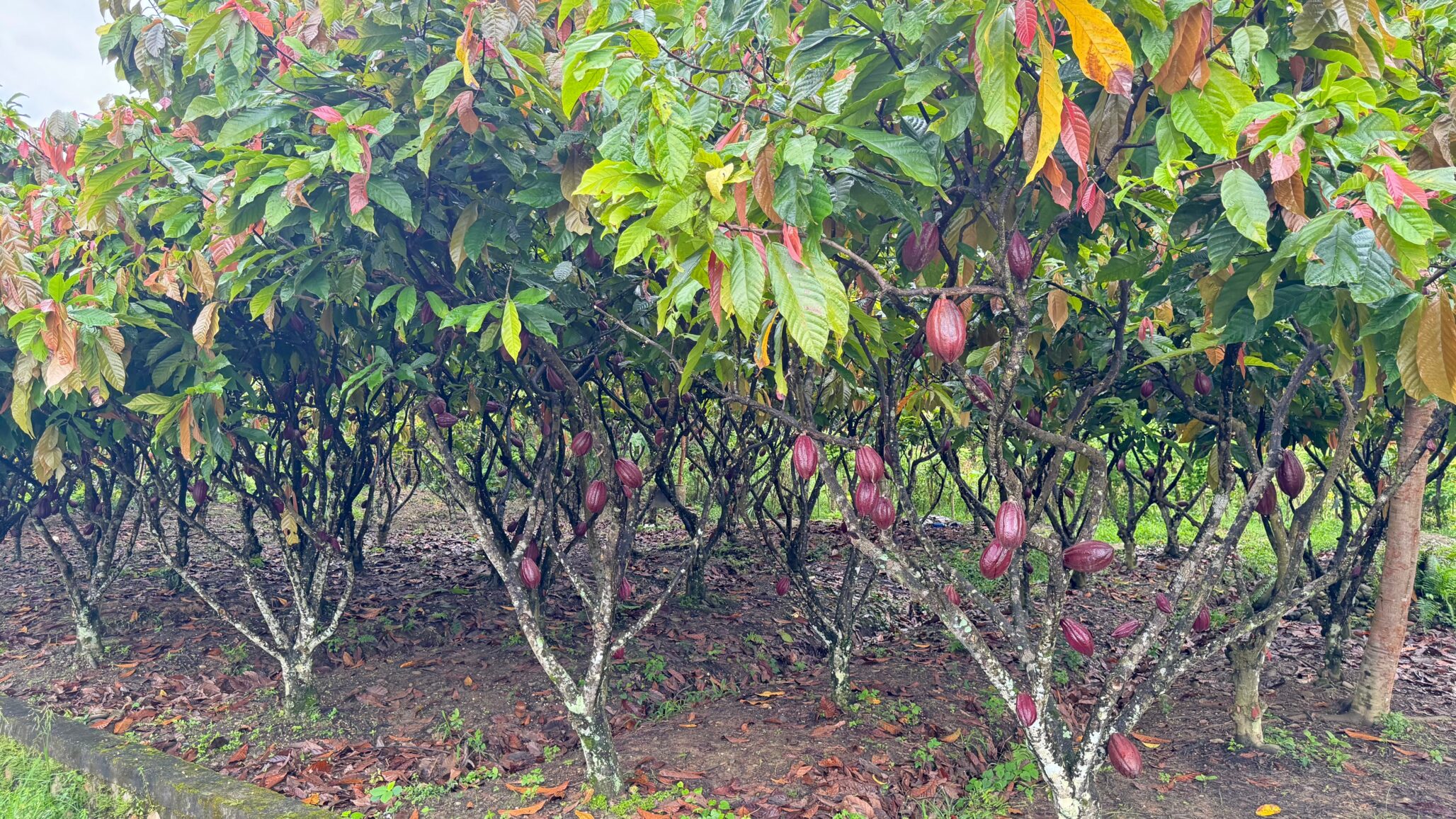
A new scientific study finds that by 2050, almost 20% of the land in Colombia that is currently suitable for cocoa cultivation may no longer have the climate conditions needed to sustain production. The biggest impacts are expected in the Caribbean lowlands and the country’s northeastern departments.
The research was carried out by the Alliance of Bioversity International and CIAT, together with Fedecacao and AGROSAVIA. It combines future climate projections with data on existing cocoa-growing areas and the distribution of wild cocoa relatives to assess how production conditions may shift over the next 25 years. The study was published in Regional Environmental Change.
According to the models, the most significant declines in suitability are likely to occur in low-altitude zones of Atlántico, Bolívar, Cesar, Córdoba, Sucre, and Antioquia, as well as in the northeastern departments of Arauca, Casanare, Meta, and Vichada.
Higher temperatures and increasingly intense or unpredictable rainfall could reduce yields, place greater stress on crops, and increase economic uncertainty for cocoa-growing families, according to a press release.
“Recent events, such as the cold wave with global implications that affected northern Colombia and caused major flooding in lowland areas of the Caribbean region and other Andean zones, show how climate change and climate variability are already generating real impacts,” said Carlos Eduardo González, researcher at AGROSAVIA and one of the study’s lead authors.
The outlook, however, is not the same across all regions. The Andean foothills — where most of Colombia’s cocoa is currently grown — are expected to remain climatically suitable. The study also projects a roughly 3% increase in suitable land, primarily in higher-altitude areas, pointing to a possible geographic shift in cocoa production as the climate changes.
These results offer valuable guidance for land-use planning and for developing targeted strategies that consider differences in climate, elevation, and environmental conditions.
“This means that cocoa in Colombia will not disappear, but will likely undergo a gradual process of geographic redistribution,” González added.
Wild Cocoa: A Strategic Resource For Adaptation
One of the study’s most important findings is that wild cocoa could spread into new areas that become climatically suitable if projected temperature and rainfall trends continue through 2050.
“Wild cocoa has an advantage that cultivated cocoa does not: it has evolved for thousands of years under extreme climate conditions. Populations that currently grow in very hot, very dry, or very wet areas are precisely those of greatest interest to us, because they may contain genes that allow us to develop varieties more resilient to future climate changes,” explained Tobias Fremout of the Alliance of Bioversity International and CIAT, who also participated in the study.
This finding highlights the need to conserve native lowland forests where wild cocoa populations occur, as these ecosystems hold valuable genetic diversity that could support the development of planting materials better able to withstand climate stress.
Scientific Basis For Policy And Adaptation
The results underscore the value of forward-looking, science-based land-use planning and practical adaptation measures. Agroforestry systems, in which cocoa is grown under the shade of other trees, can help regulate temperatures and retain soil moisture.
In areas likely to experience more frequent droughts, supplemental irrigation may play an important role in maintaining stable production. These strategies can be strengthened through crop diversification and the use of more resilient genetic materials.
In this context, access to reliable climate information will be essential to support producers and inform decision-making by institutions such as the Ministerio de Agricultura, UPRA, and Fedecacao, helping to reduce risks and safeguard the long-term sustainability of Colombian cocoa.
The study’s findings will also be incorporated into the platform www.cacaodiversity.org to help identify the most effective farm-level adaptation options for cocoa cultivation.