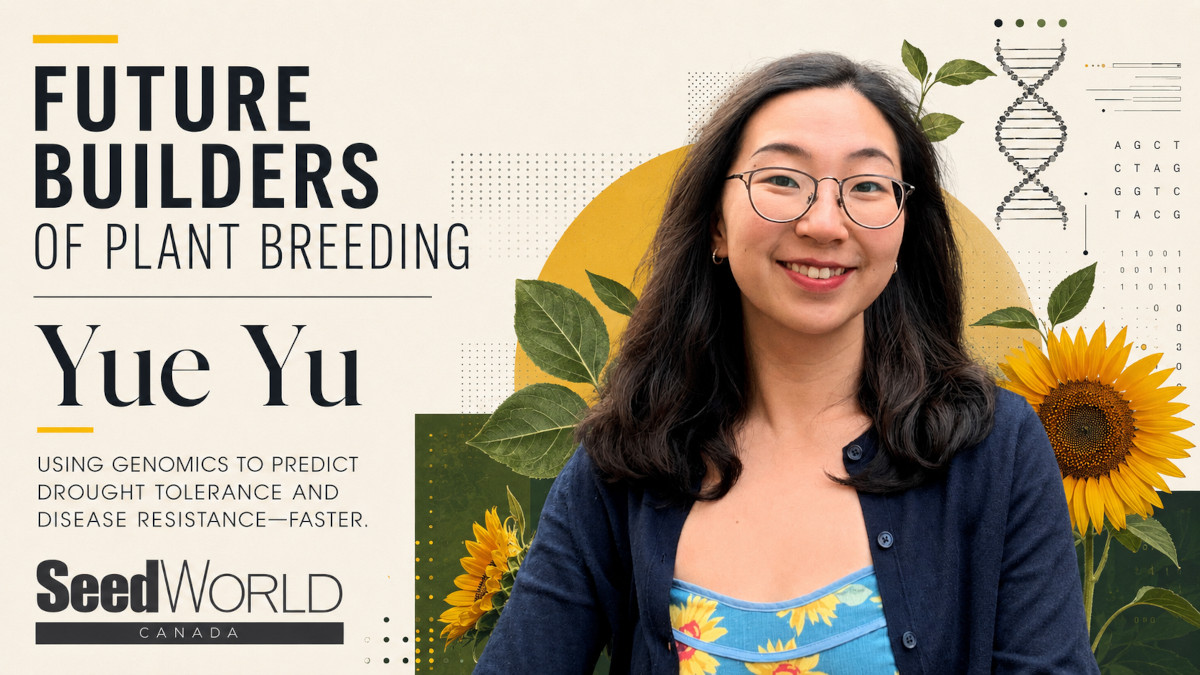
UBC PhD candidate Yue Yu is developing genomic tools that predict which plants are most likely to thrive, giving breeders a faster route to resilient cultivars.
Ask Yue Yu what she wants to do in her career, and the answer is short. She wants to apply genomics to solve real-world problems in plant breeding.
Everything she’s done, from conserving Canada’s forests to improving sunflower resilience, studying international genetic resource policy and helping train the next generation of scientists, points toward that single goal.
As a PhD candidate in evolutionary genomics at the University of British Columbia under internationally renowned plant geneticist Loren Rieseberg, Yue belongs to a new generation of researchers who see no boundary between fundamental science and practical crop improvement. Plant breeding has always depended on finding better plants. Yu is asking whether breeders can find them faster.
Her research applies genomic prediction and landscape genomics to identify drought-tolerant sunflower cultivars without relying exclusively on years of expensive field trials. By combining greenhouse experiments, genomic information from wild sunflower relatives and advanced modelling, she’s working to improve selection efficiency as drought becomes an increasingly common challenge across the Canadian Prairies and worldwide.
She’s also tackled another major breeding challenge: Verticillium wilt.
Her work with collaborators from Inner Mongolia Agricultural University identified resistant sunflower lines, uncovered the complex genetics behind disease resistance and pinpointed candidate genes that breeders can use to develop more resilient cultivars.
But perhaps her contribution and interest began in an entirely different crop. During her master’s research, Yue pioneered the first validated, region-wide application of landscape genomics to define seed and breeding zones for lodgepole pine in Western Canada — research that pioneers new strategies to guide seed transfer, conservation and climate adaptation.
Yue doesn’t view plant breeding as something that ends when a new variety is released. She sees it as part of a much larger system.
Rieseberg describes her as “an outstanding early-career scientist” whose work combines academic excellence with innovation and a deep commitment to translating genomic research into practical agricultural outcomes. He also highlights her leadership in teaching, mentoring and science communication, saying she represents “the very best of the next generation of plant breeders and geneticists.”
WHAT SHE’S BUILDING: A new way to breed plants, using genomics to predict which ones will thrive before years of field trials ever begin.
—Editor’s Note: This is the first in a 7-part series on future buildings in plant breeding. Stay tuned for more!