Long before recent federal cuts made headlines, Canadian farmers were quietly underwriting the country’s wheat breeding system.
–This story is Part 2 of 3. For the first instalment posted yesterday, click here.
Over the past five years, farmers have invested more than $100 million into public and collaborative research efforts — a commitment that underscores both their stake in innovation and their growing concern about the system’s stability.
If the crisis has surprised some observers, it has not surprised farmers. They have, in many respects, been underwriting the system for years.
“Farmers fund almost half of wheat breeding in Canada,” Velestuk notes. Since 2020, she says, farmers have invested roughly $45 million into the AAFC public breeding program and an additional $70 million into the broader wheat innovation system.
That scale of investment prompted CWRC — a collaboration among Manitoba Crop Alliance, Saskatchewan Wheat Development Commission and Alberta Grains — to commission a comprehensive review of Canada’s wheat breeding innovation system last year.
The review, conducted before the most recent AAFC cuts, involved interviews with 29 stakeholders across the system: breeders, university researchers, federal scientists and private sector participants. Its findings are expected to inform future funding and governance discussions.
Yet the urgency has intensified. “As a farmer about 80 kilometres from Indian Head, I understand how important these research stations are,” Velestuk says. “It takes over 13 years to move from germplasm to a variety in farmers’ hands. You can’t afford big gaps.”
The Municipal Experiment
If the federal government’s retrenchment has unsettled the system, some local actors have moved in the opposite direction.
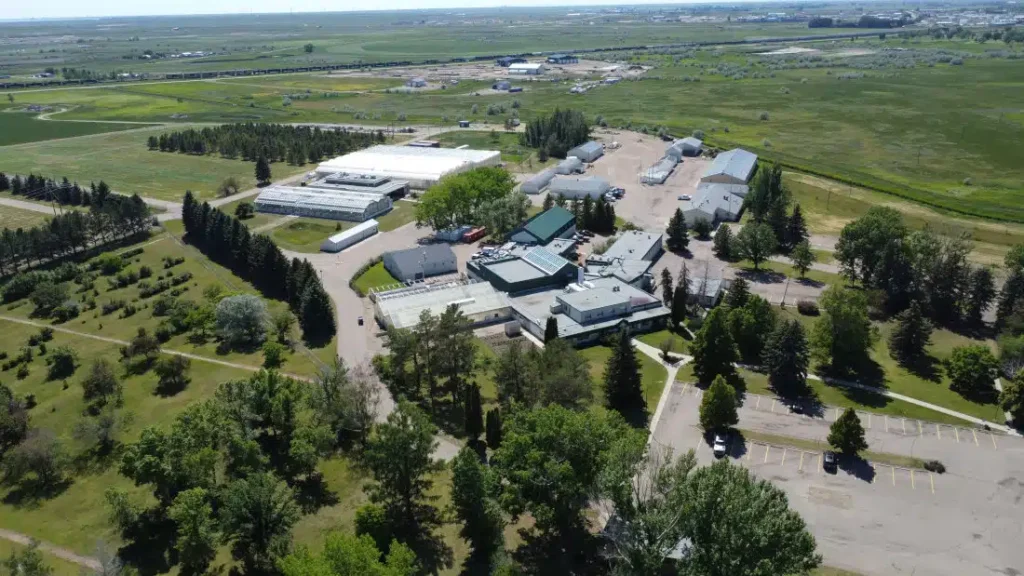
In Brooks, Alta., the County of Newell recently assumed responsibility for Crop Diversification Centre South, a former provincial research facility. Municipal leaders adopted a cost-recovery model designed to attract private and public research partners.
“It was hard to see a research station sitting there largely underutilised,” says Candace Woods, project coordinator for the county. “It mattered to us that there was active research coming out of that facility.”
The county’s approach is pragmatic. “Our ratepayers don’t want to be on the hook to fund it entirely,” Woods says. “Partnerships are essential.”
Todd Green, the county’s agricultural services director, describes the ambition as creating a “campus-style environment” where researchers collaborate on practical problems. “Success is paying the bills, keeping the lights on, and having meaningful research happening,” he says.
The experiment is small in national terms. But it hints at a broader rethinking of governance: might hybrid models fill some of the gaps left by federal pullback?
A Question of Talent
Beyond infrastructure and funding lies a subtler concern: human capital.
Canada’s universities continue to produce well-trained plant scientists. But will they stay?
“My biggest fear is that we become a net exporter of intellectual capital,” Derkatch says. “If we can’t provide long-term, sustainable employment opportunities, those innovators will go elsewhere.”
The global competition for plant-breeding talent is intensifying. Emerging technologies — genomic selection, gene editing, digital phenotyping — demand both capital and expertise. Countries that provide stable funding environments and clear pathways for commercialization will attract both.
“We should have an ‘own the podium’ mindset,” Derkatch argues, invoking Canada’s Olympic strategy. “We should be attracting leading experts from outside Canada to invest here.”