Boomtown Street celebrates the past. It also reminds us what happens when successful institutions stop evolving. This week’s stories show why adaptation has become agriculture’s greatest competitive advantage.
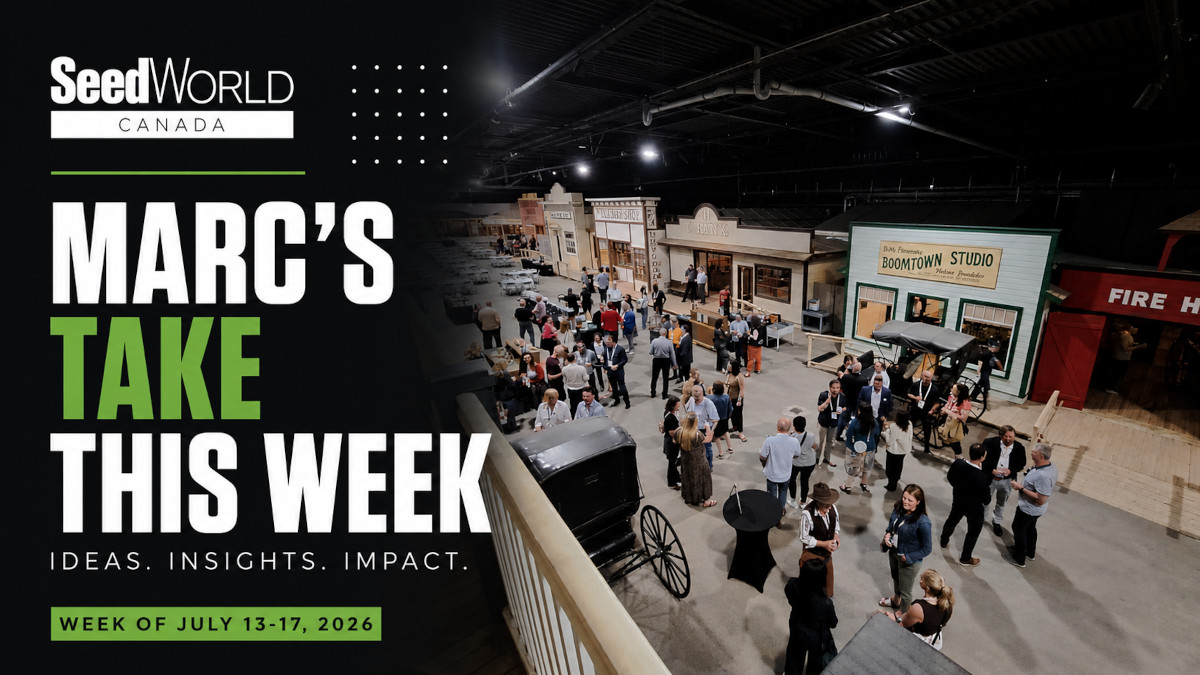
Last week, during the Seeds Canada annual meeting in Saskatoon, attendees visited Boomtown Street, the Western Development Museum’s recreated 1910-era Prairie town. It was an enjoyable evening, but it also felt surprisingly relevant to many of the conversations taking place in the seed industry right now.

Boomtown Street captures a moment when Prairie communities were being built around the railway, the grain elevator, the local merchant and a rapidly growing agricultural economy. The people who built those towns were responding to the needs and opportunities of their time. Their businesses, institutions and ways of working made sense because they reflected the world around them.
The lesson is not that those people got it wrong. The lesson is that even successful systems eventually have to change. That idea connects many of the stories we covered this week.
The Canadian Seed Growers’ Association announced Cathy-Jo Noble as its next executive director. She does not come from the seed sector, but she brings extensive experience in public affairs, government relations and agricultural leadership. The fact she’s not from the seed sector itself is a recognition that the challenges facing the sector are becoming broader.
Seed organizations still need technical expertise, but they also need leaders who can navigate government, build coalitions, communicate with the public and make the case for agriculture in a crowded policy environment. The skills required to protect and strengthen the seed system are changing because the environment around it is changing.
The same is true of wheat breeding. Canada’s public wheat breeding system has delivered enormous value to farmers and the wider economy, but the funding model supporting it is under pressure. The debate is no longer about whether public breeding has worked. It clearly has. The question is whether the system is financially equipped to continue doing that work in the decades ahead.
A system can have a proud history and still require a new approach. Canadian Plant Breeding Innovation Scholarship recipient Neha Paserkar’s research at McGill University offers another example. Her work examines how climate change could alter the relationship between crops and diseases such as sclerotinia.
Plant breeders have always worked to improve disease resistance, but climate change is making that task more complicated. Warmer temperatures and shifting environmental conditions could affect how pathogens behave and how plant resistance functions. That means tomorrow’s breeders may not be able to rely entirely on the assumptions that shaped yesterday’s breeding programs. They will need new tools, new data and a deeper understanding of how genetics, disease and the environment interact.
Senator Robert Black’s work on soil health reflects a similar change in thinking.
For years, soil has often been discussed mainly as an environmental or agronomic issue. Describing soil as strategic infrastructure gives it a much broader significance. Roads, railways and ports are treated as infrastructure because the economy depends on them. Agriculture depends just as heavily on healthy soil. Once soil is viewed that way, questions about research, conservation, productivity and long-term investment begin to look different.
The industry also spent time recognizing people who have devoted decades to building Canada’s seed sector. CSGA honoured four leaders whose careers helped shape seed production, regulation and industry cooperation. We also reflected on the contributions of leaders who helped build Seeds Canada and carried the sector’s concerns into Parliament.
Those stories matter because change should not be confused with rejecting the past. The institutions the industry is now trying to modernize exist because earlier generations built them carefully. They created the standards, organizations and relationships that made Canada’s seed system respected around the world.
The best way to honour that work is not to preserve every part of the system exactly as it is. It is to carry forward the same willingness to adapt that allowed those leaders to succeed in the first place.
That was the lesson I took from Boomtown Street. The town represents a period of extraordinary growth and optimism, but it also reminds us that industries and communities are always shaped by forces beyond their control. Technology changes. Markets shift. Political priorities move. Scientific challenges become more complex.
The danger is not that an industry will suddenly forget everything it knows. It’s that it will continue relying on assumptions that no longer match reality. Canada’s seed sector has deep expertise, strong institutions and a history of innovation. Those strengths give it a solid foundation, but they do not remove the need for change.
The real challenge is to decide what must be preserved, what must be rebuilt and what must be approached in an entirely new way. Boomtown Street is worth visiting because it brings the past to life. For the seed industry, it also offers a reminder that the goal should never be to slavishly stick to something that once worked. The goal is to keep building.