We often focus on designing new systems to accelerate innovation. But perhaps the more important question is whether we’re adequately stewarding the institutions, relationships and frameworks that have enabled innovation all along.
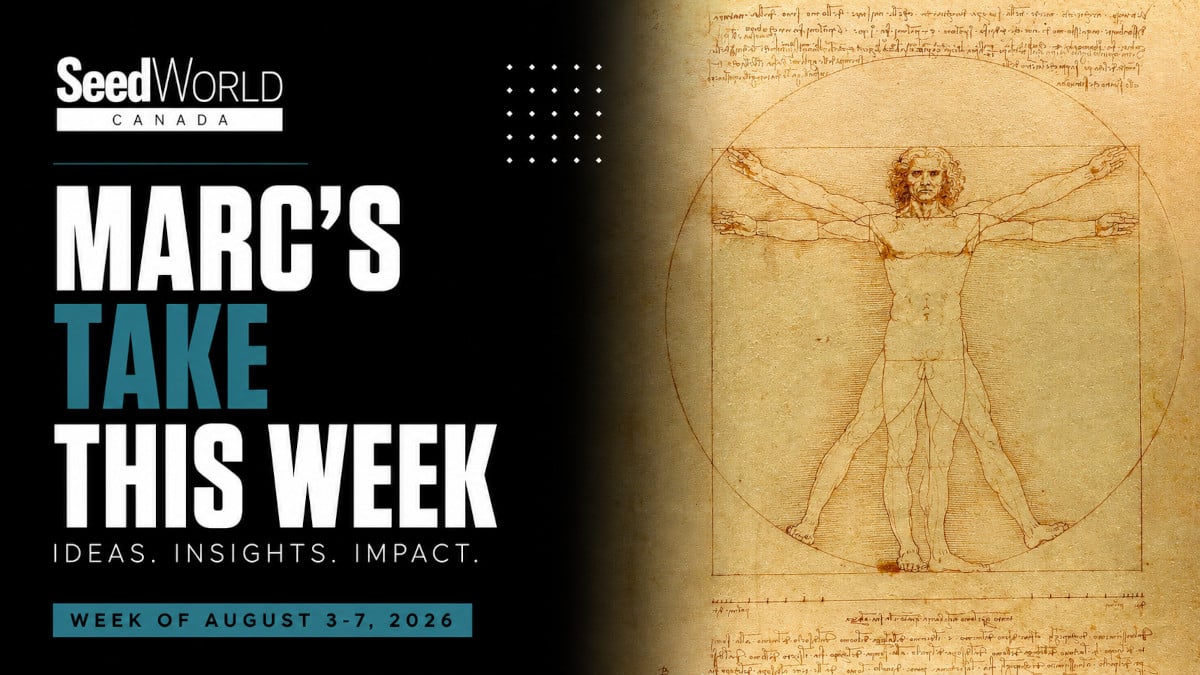
Leonardo da Vinci’s Vitruvian Man is one of the most recognizable drawings in history. Most people see it as a study of the human body. It’s actually something much bigger.

Inspired by the Roman architect Vitruvius, da Vinci was exploring the idea that greatness comes from proportion — that every part of a system has a relationship to every other part. The figure isn’t remarkable because of any single arm, leg or hand. It’s remarkable because everything works together in balance.
Innovation works much the same way.
This week, three stories reminded me of that.
In this week’s On the Brink, the conversation turns to the Variety Use Agreement. It’s easy to get lost in the technical language, but the underlying question is straightforward: how do we ensure new varieties deliver meaningful value to farmers while giving breeders the confidence to invest in developing them? It’s a conversation about incentives, public trust and creating the conditions that allow innovation to flourish.
Outgoing Canadian Seed Growers’ Association president Glenn Logan reflects on leading through one of the most significant periods of seed regulatory modernization in Canada’s history. His biggest lesson wasn’t about regulations themselves. It was about listening. Lasting change requires organizations that can balance competing perspectives while keeping the health of the entire system in mind.
Then there’s Mark Sorrells.
After four decades at Cornell, one of North America’s most respected wheat breeders is stepping away from a career defined not simply by varieties released, but by people developed. His legacy is measured in students mentored, collaborations forged and scientific capacity strengthened. His career is a reminder that plant breeding has never been an individual pursuit. It’s a relay race.
At first glance, these stories seem unrelated.
One is about intellectual property. One is about governance. One is about scientific achievement.
But they’re really about the same thing.
We often talk about the next breakthrough variety as though it begins with a brilliant breeder making a brilliant discovery. In reality, breakthroughs emerge from an ecosystem.
Researchers need sustained investment. Breeders need regulatory frameworks that encourage innovation rather than discourage it. Growers need confidence that new genetics solve real problems. Industry organizations need leaders who can build consensus instead of division. Universities need to prepare the next generation before today’s experts retire.
Each of these pieces matters. None of them is sufficient on its own.
That’s what Vitruvian Man teaches us. A system isn’t defined by the excellence of its individual parts, but by how well those parts fit together. Change one proportion, weaken one connection, and the harmony begins to disappear.
Our industry sometimes debates these issues in isolation. Should we modernize regulations? Should we rethink the Variety Use Agreement? How should public breeding evolve?
They’re all worthwhile conversations.
But perhaps the more important question is whether we’re maintaining the balance of the entire innovation ecosystem. Because the system is only as resilient as its weakest connection.
A world-class breeder can’t succeed without sustained investment. Modern regulations won’t work without trust. Excellent science has limited impact if knowledge isn’t passed to the next generation.
Innovation isn’t simply the product of discovery. It’s the product of relationships.
As leaders like Glenn Logan and Mark Sorrells reflect on careers dedicated to strengthening Canadian and North American agriculture, and as conversations around the Variety Use Agreement continue to shape our future, we’re reminded that agriculture’s greatest competitive advantage has never been a single technology or policy.
It’s the remarkable system we’ve built over generations — one where research, regulation, leadership, growers and industry each have a role to play. Like da Vinci’s famous drawing, its strength comes not from any one part, but from the balance between them.
That’s the legacy and the system we should be working to preserve.