Breeders, researchers and farmers have to make decisions years before they know which ideas will succeed.
A farmer can’t plant potential. At some point, an idea has to become a seed that performs in a field, fits a rotation and earns its place on the farm. That sounds obvious. What is less obvious is how many decisions must be made before anyone knows whether the idea will work.
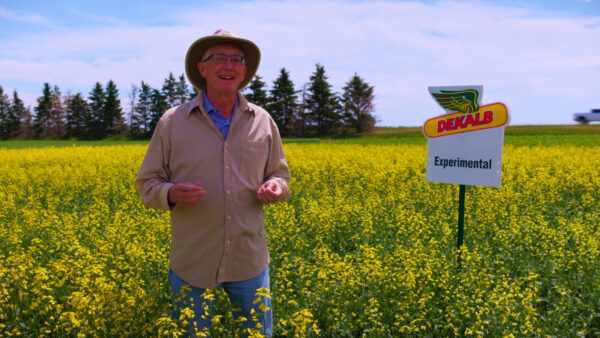
Michel McElroy is making those decisions in Quebec, where winter wheat has become a more serious option for growers looking to strengthen their rotations. As he explains in the latest On the Brink, a breeding decision made now may take five to 10 years to reach a farmer. Genomics can help him make some decisions sooner, but it can’t tell him with certainty what growers will need a decade from now.
At UC Davis, Reagan Reed is asking a question much closer to the beginning of a plant’s life: can changing genes involved in germination help a seed establish a healthy plant under more conditions? The work is precise, but the outcome he cares about is practical. A stronger start could give a crop a better chance. Whether a finding in the lab eventually becomes something farmers can use is another question altogether.
Then there is the question of what farmers might grow for. Darcy Pawlik of Ag-West Bio argues that some of Canada’s opportunities could start with a few acres of a new crop, a distinct trait or a specialized use. The market, processing capacity and business model may have to be developed alongside the crop.
These are different kinds of uncertainty. McElroy has to choose which future traits to pursue. Reed has to discover whether a promising biological change delivers a useful result. Pawlik has to help people find out whether someone will buy that result at a price that makes growing it worthwhile.
I think we sometimes talk about innovation as though uncertainty is a flaw to be removed before we commit. But if we wait for every answer, we leave little room to develop anything unfamiliar. Quebec’s winter wheat acres didn’t grow because someone could guarantee the crop’s future years in advance. A better seed won’t emerge from a lab without people willing to test what its early results mean. A new market can’t prove itself at commodity scale on its first day.
That doesn’t mean every idea deserves unlimited support. Farmers are right to ask hard questions about performance, buyers and risk. Those questions should guide the work from the start.
It does mean we need ways to keep promising possibilities alive long enough to answer them. Breeding programs need continuity. Young researchers need teams and places to test their ideas. Farmers trying a crop for a new purpose need customers and infrastructure that can grow with them.
The seed sector’s job is often described as delivering the next better variety. I would put it a little differently. Our job is to make sure that when the next opportunity appears, we have given it a fair chance to become real.