As breeding tools become more powerful, Canada’s testing, delivery and funding systems are becoming just as important as the science itself.
For a long time, the easiest way to talk about plant breeding was to talk about the variety. More yield. Better disease resistance. Earlier maturity. Improved quality. Those things still matter. But after spending much of this year talking with breeders, seed growers, farmers and researchers, I’m more and more convinced that focusing only on the variety misses what may be the biggest challenge facing Canadian plant breeding.

We have to get much better at everything around the variety.
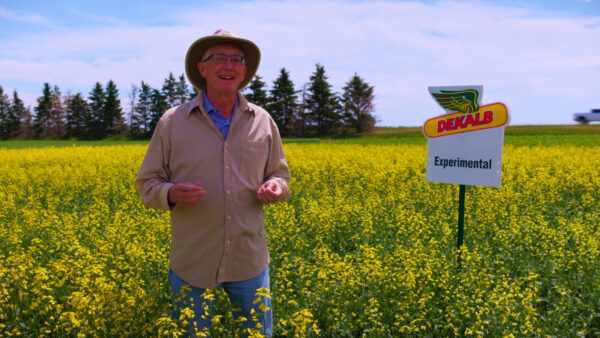
Consider canola. Bayer breeder Dale Burns describes how the definition of a better hybrid has expanded dramatically during his career. Yield remains central, but breeders are also thinking about how much material has to pass through a combine, how quickly a crop dries down, whether pods can withstand a few more days in the field and whether a farmer can eliminate a pass with the sprayer.
Those may sound like incremental improvements compared with a big yield jump. On a farm during harvest, they can be immensely valuable. A variety that gives someone another few days of harvest flexibility or allows them to cover acres faster is doing something that doesn’t necessarily show up neatly in a yield plot.
That is an important shift: breeding for the farm business, not merely the crop. But developing those traits is only the beginning, because farmers also need evidence that the genetics will work where they farm.
That’s why the concern Alberta-British Columbia Seed Growers President Sarah Weigum is raising about regional variety testing deserves attention. If research capacity contracts and regional trials disappear with it, we don’t just lose some plots — we weaken the mechanism that allows a farmer to look at a new variety and decide whether taking a chance on it makes sense.
There’s a strange contradiction in spending millions to develop better genetics and then underinvesting in the infrastructure that helps farmers confidently adopt them.
The same lesson is emerging in pulse breeding. Genomic selection has enormous potential for crops such as peas and lentils, but the interesting part of the story isn’t simply the technology. It is the network being assembled around it. AAFC, the Crop Development Centre, the Global Institute for Food Security, grower organizations and private companies are pooling expertise, infrastructure and data because some of these tools have become too expensive and complex for organizations to build effectively on their own.
That model acknowledges something we sometimes don’t want to admit: innovation is increasingly a team sport. There should absolutely be competition. Companies and breeding programs should compete to produce better varieties. But there are places where collaboration can make everyone stronger — sequencing capacity, datasets, regional testing, foundational research and other infrastructure that individual organizations struggle to justify alone.
Then comes the final question: who pays?
Kelly Barany raised that issue recently on On the Brink. Every new variety requires someone to take a risk. Breeders can spend years developing something before knowing whether farmers will adopt it. Farmers, meanwhile, put land, inputs and an entire growing season behind a variety before they know whether it will deliver on their farm.
That means a successful breeding system has to create value at both ends. The farmer needs a variety worth changing for. The breeding organization needs enough return to keep breeding. Those two ideas are sometimes treated as opposing interests, but they shouldn’t be. They are two halves of the same system.
And that is where I think the conversation about Canadian plant breeding needs to go next. We spend a lot of time debating public versus private breeding, funding models, intellectual property and who should be responsible for various pieces of the system. Those debates matter, but perhaps the more useful question is whether the entire chain actually works.
Can we identify what farmers need? Can breeders turn those needs into genetics? Can we give them the tools and stable funding required to do it? Can we test those genetics across the environments where farmers will actually grow them? Can seed businesses multiply and deliver them efficiently? Can farmers see enough evidence of value to adopt them?
And when the whole process succeeds, can enough of that value flow back into the system to finance the next generation of innovation? If the answer breaks down anywhere along that chain, even an extraordinary new variety can struggle to make an impact.
The future of Canadian plant breeding, then, may depend less on finding one revolutionary technology or funding mechanism than on making all these pieces work together. Because the real measure of a breeding system isn’t how many varieties it creates. It’s how much useful genetic progress actually reaches the farm.