Tufts University researchers developed battery-free leaf and stem sensors that monitor plant water loss, growth and stress before visible symptoms appear.
Researchers at Tufts University have developed wearable sensors for plants that could help farmers detect crop stress before leaves curl, growth slows or other visible damage appears.
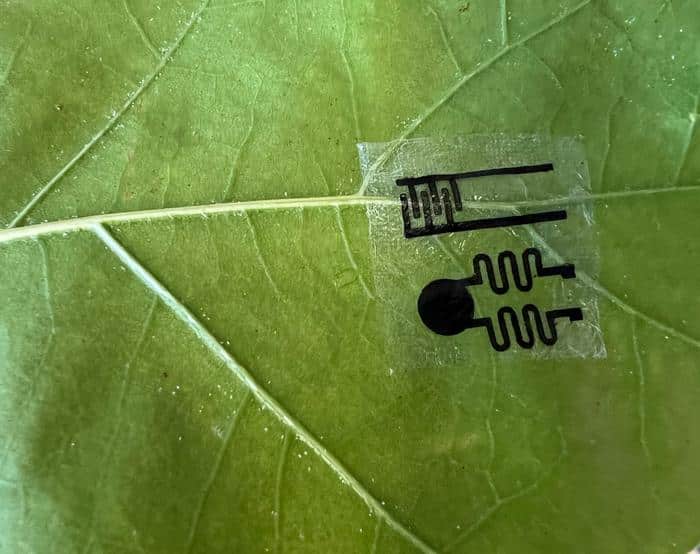
The system includes a thin, tattoo-like sensor attached to the surface of a leaf and a stretchable band wrapped around the stem. Together, they monitor temperature, humidity, water loss and stem growth.
The sensors do not require an external battery. Instead, they generate small amounts of electricity from moisture evaporating from the plant.
A Plant-Level Early Warning System
“The larger promise is not merely that one plant can wear one sensor,” said Sameer Sonkusale, professor of electrical and computer engineering at Tufts and senior researcher in the project. “It is that fields could one day contain networks of plant-level monitors, each reporting early signs of thirst, salt stress, disease or nutrient imbalance. Satellites and drones already give farmers a bird’s-eye view. Plant wearables could provide something more intimate: the plant’s-eye view.”
Satellites, drones, soil sensors and weather stations already provide information about crop conditions. However, these tools often measure environmental risks or identify damage after it has occurred.
“The leaf sensor is more of an early warning system showing how the plant is responding in the moment, before visible signs appear,” said Nafize Hossain, a graduate student at Tufts who led the research in the Sonkusale lab.
Researchers say future versions could also monitor nutrients, plant hormones and early responses to pathogens, according to a press release.
Flexible Sensors Track Water Loss and Growth
The leaf sensor resembles a temporary tattoo. It is thin and flexible enough to adhere to uneven leaf surfaces while allowing the plant to bend and exchange gases normally.
“Other plant sensors exist, but their ability to track multiple stressors and growth-related parameters is limited,” said Hossain, “and the technology often relies on external batteries, which complicate field deployment.”
The device measures vapour pressure deficit, or VPD, which indicates how strongly the surrounding air draws moisture from a plant. High VPD can cause plants to close their stomata to conserve water, slowing photosynthesis and growth.
The sensor uses layers of vanadium pentoxide nanosheets and graphene. Moisture moving from the leaf through the sensor generates an electrical current, allowing the device to function as both a sensor and a small power source.
Stem Band Shows Slower Stress Responses
The stem sensor uses a stretchable pattern inspired by kirigami, the Japanese art of cutting paper. It is coated with an ion-conducting gel that changes electrical resistance as the stem expands or contracts.
Healthy stems generally increase in diameter as plants grow. Under water or salt stress, growth may slow or stems may shrink.
Combining the two sensors allows researchers to measure stress over different time periods. The leaf device records immediate changes in water loss, while the stem sensor tracks longer-term effects on plant growth.
Bell Pepper Tests Identify Water and Salt Stress
Tests on bell pepper plants showed that the system could distinguish healthy plants from those experiencing water shortages or salinity stress.
Healthy plants displayed regular daily changes in VPD. Water-stressed plants showed rising VPD, while salt-stressed plants produced a different pattern linked to changes in water uptake and stomatal activity.
The stem sensor also recorded normal growth in healthy plants and reduced growth or shrinking in stressed plants.
The devices were designed to withstand field conditions, including bending, stretching and sudden movements caused by wind.
Researchers are now developing a wireless communication system using LoRa or Bluetooth technology to transmit sensor data.