Navigating the Seed Labeling Maze: How One Database Helps Seed Companies Avoid Costly Delays and Keep Products Moving
Every bag of seed shipped across state lines carries more than seed. It carries a label.
That label may look straightforward, but behind it sits a maze of federal regulations, state-specific requirements and countless details that can determine whether a shipment moves on schedule or gets stopped.
Most seed companies know the routine. Someone searches state regulations, compares requirements, checks websites, makes phone calls and hopes nothing has changed since the last shipment.
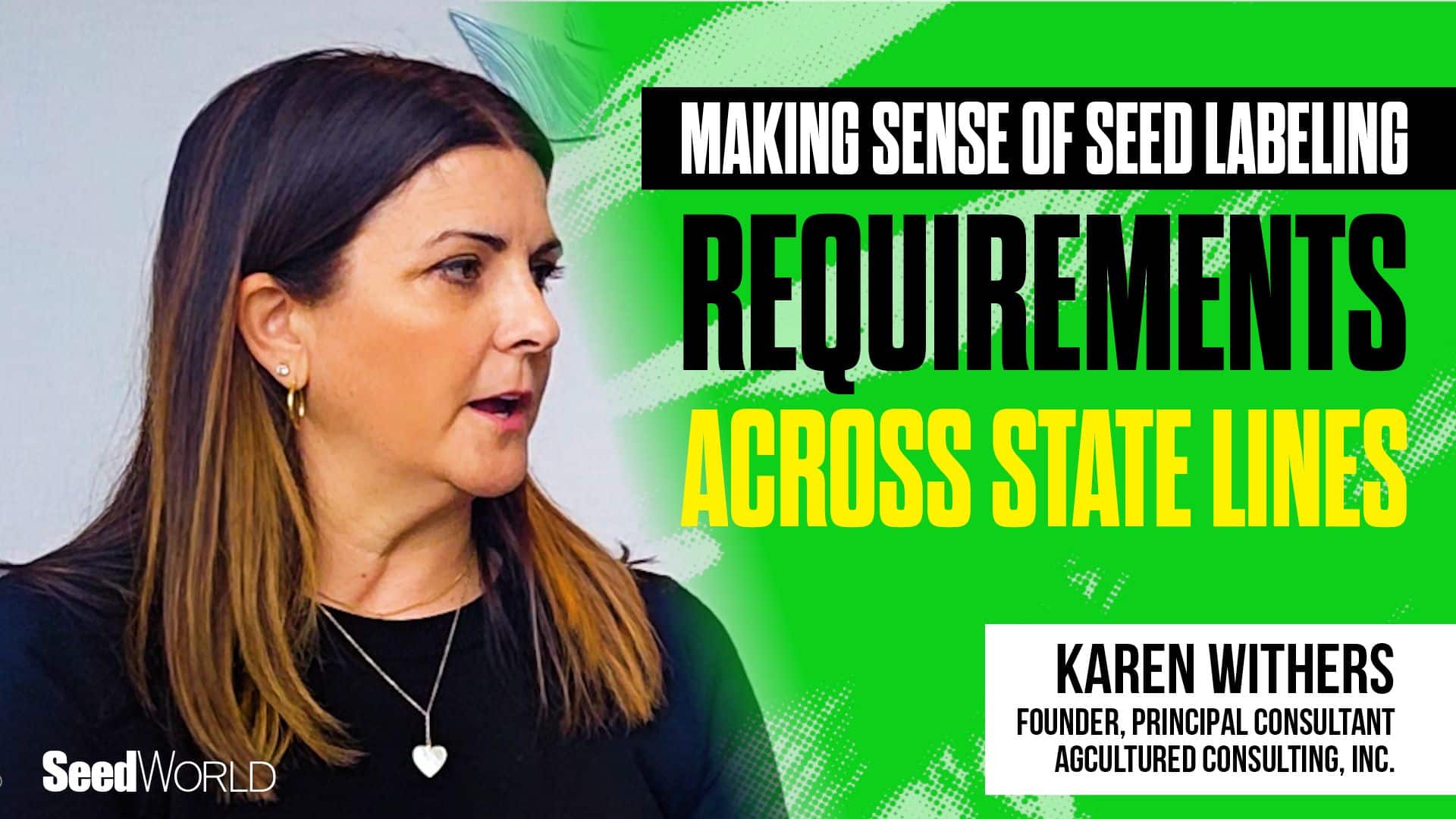
“It’s mandatory,” says Karen Withers, AgCultured Consulting LLC founder. “As boring as labeling is, it’s one of the driest topics, but it’s very important to every single seed company globally.”
For years, there was no single place to find the information companies needed. Every state maintains their own regulations, and while federal law establishes baseline requirements, states often added their own rules.
That reality inspired the Oregon Seed Association to build something the industry had never had before.
The OSA Seed Labeling Database brings together state seed labeling requirements from all 50 states into one searchable resource. Companies can compare state requirements, locate regulatory contacts and verify labeling information before products leave the warehouse. As one survey respondent described it, the database has become “one stop shopping for current and accurate information.”
The resource has quickly grown beyond its Oregon roots.
Today, companies across the United States use it, along with users in Canada, Europe and New Zealand. State regulatory agencies direct companies to it, universities use it as a teaching resource and new funding will allow the project to expand significantly over the next two years.
Fifty States, Fifty Different Rulebooks
The Federal Seed Act establishes minimum labeling requirements for agricultural and vegetable seed sold in interstate commerce. But, that’s only part of the story.
Individual states can require additional information ranging from arbitration statements and treated-seed language to relabeling requirements, expiration dates, font sizes and color specifications. Some define terms differently. Others establish unique requirements for particular crops or products.
“There are federal requirements, but then every state may have additional requirements,” Withers says. “All the states have their own way of doing things, and while that is absolutely fine and fair, it does complicate things for the seed shipper just to make sure they’re on top of all those regulations. That’s what makes this really important. It’s all in one location rather than having to go to every state website.”
Those differences create a significant workload for companies shipping seed nationwide.
During development of the database, Withers reviewed every state’s seed laws and regulations, comparing each requirement against federal standards. What began as a project focused on core labeling requirements quickly uncovered layers of state-specific rules that weren’t included in the original grant.
“We learned there’s also still a lot of other information that states regulate,” Withers says.
Those discoveries helped shape the database’s next phase.
Preventing Problems Before They Happen
Sometimes the value of compliance only becomes obvious after something goes wrong.
Withers recalls a seed company whose shipment to California was delayed because of a labeling issue.
Using the database, the company quickly identified the correct regulatory contact and the information needed to resolve the issue. But the experience also highlighted how the problem could have been avoided in the first place.
But the bigger lesson came afterward.
“It did help facilitate a solution,” Withers says. “But we also said, ‘If you want to use this in the beginning, you might have been able to prevent that issue.”
The experience reinforced the database’s purpose.
Rather than replacing regulators, it helps companies answer routine questions before printing labels or shipping seed. Users can compare state requirements, connect directly with the appropriate regulatory agency and verify information without searching dozens of websites.
State agencies benefit as well.
When companies call with questions about another state’s regulations, officials can direct them to the database instead of trying to interpret requirements outside their own jurisdiction. The shared resource has become valuable on both sides of the conversation, helping regulators answer questions more efficiently while giving companies greater confidence before products move into the marketplace.
Traffic continues to grow, and users say the database is changing the way they approach compliance.
According to an OSA survey, companies using the database reported efficiency improvements ranging from 10% to 50%. Several respondents also described finding problems they didn’t know existed until they began using the tool.

“We have found errors with our old method thanks to this database and now use it exclusively,” one respondent wrote.
“Our templates have been wrong for years! After using the database, we have been able to fix them and now feel confident our labeling is accurate,” another respondent wrote.
“Even on the low end, a 10% efficiency improvement just by using this single tool in their labeling department is still incredible,” Withers says. “That saves a lot of time.”
More Than a Labeling Tool
The original grant focused on information required under the Federal Seed Act. Now OSA plans to build something much larger.
A newly secured funding source will support development of additional compliance tools over the next two years. While details about the funding partner will be announced later this year, the expansion is already taking shape.
Future additions include state quality standards, labeling best practices, regulatory definitions, relabeling requirements, frequently asked questions and downloadable templates.
Perhaps the most anticipated addition is a searchable noxious weed seed database. The tool will allow companies to enter a weed species and quickly determine where seed containing that species can or cannot be shipped based on state regulations.
For companies navigating increasingly complex compliance requirements, that information could eliminate hours of research. The expanded database also reflects lessons learned during development of the original project.
As Withers worked through regulations from all 50 states, she identified recurring questions from seed companies and recognized information that simply wasn’t available in one place.
The next phase aims to close those gaps.
Technology Still Needs Human Expertise
Artificial intelligence has become part of nearly every business conversation, and regulatory compliance is no exception.
Withers believes AI can help users gather information, but she isn’t ready to trust it with compliance decisions.
“AI is absolutely incredible,” she says. “It will give you lots of information. But from my experience, it’s not always accurate.”
She expects AI to become another research tool, not a replacement for subject matter expertise.
“I have a hard time seeing it replacing regulatory information accurately or anytime soon,” she says. “There still needs to be a human to interpret and accurately compile information and review it for accuracy.”
For an industry built on precision, accuracy remains nonnegotiable. Seed labels may never attract much attention when everything goes according to plan. But every shipment depends on getting them right.
The OSA Seed Labeling Database won’t eliminate the complexity of state regulations. Withers says it wasn’t designed to do that.
Instead, it gives seed companies something they’ve never had before: one place to navigate one of the industry’s most complicated compliance challenges before a shipment ever leaves the warehouse.
An Accidental Seed Expert
Karen Withers never planned to build the seed industry’s go-to resource for labeling compliance. She simply kept saying yes to opportunities that stretched her.
She knew she wanted to work in agriculture long before she knew the seed industry existed.
Growing up on a small family farm in Oregon’s Willamette Valley, she dreamed of an international career. After earning a degree in international agricultural economics from Oregon State University, she landed a job managing bulk grain exports. It checked every box she had imagined.
Seed came later — and almost by accident.
After buying her first home, Withers admired the immaculate lawn across the street. Her neighbor noticed her attempts to recreate it and eventually wandered over carrying a bag of grass seed. He happened to be a turfgrass breeder.
“No wonder I’ll never have a lawn as beautiful as this guy’s,” Withers remembers thinking.
The conversation led to introductions within Oregon’s seed community and, eventually, a position with a local seed company. She spent the next 15 years managing international sales and exports while building relationships across the industry.
Those relationships ultimately shaped the next chapter of her career.
When her children were young, Withers made a difficult decision. She stepped away from a job she loved to spend more time with her family.
“I wanted to spend more time with my kids as they were growing,” she says.
She didn’t know what came next.
Then the phone started ringing… and kept ringing.
Former colleagues continued calling with technical questions about exports, phytosanitary certificates and international regulations. One finally suggested something she hadn’t considered.
“Why don’t you start a business so I can pay you for this assistance?”
In 2017, she launched AgCultured Consulting, LLC.
“The defining moment of my career was taking a leap of faith to start AgCultured Consulting,” Withers says. “It allowed me to put my family first while creating a career built on the experience, relationships and reputation I had developed over the years. That decision became the foundation for every opportunity that followed.”
Her advice to newcomers echoes the approach that shaped her own career.
“Put yourself out there and say yes to opportunities that challenge you,” she says.
She traces much of her professional growth to attending her first American Seed Trade Association meeting early in her career.
“It introduced me to an incredible network of people, many of whom are still friends and colleagues today,” she says. “More importantly, it opened the door to industry activities beyond my day-to-day job, broadening my perspective and accelerating my professional growth.”
Those experiences reinforced a lesson she still shares with young professionals.
“Attend meetings, volunteer, ask questions and meet new people,” she says, adding that while, technical expertise opened doors, relationships have kept them open.