Geopolitical instability and rising food prices could define the next several years, putting the seed industry’s ability to innovate, adapt and produce more with fewer resources to the test.
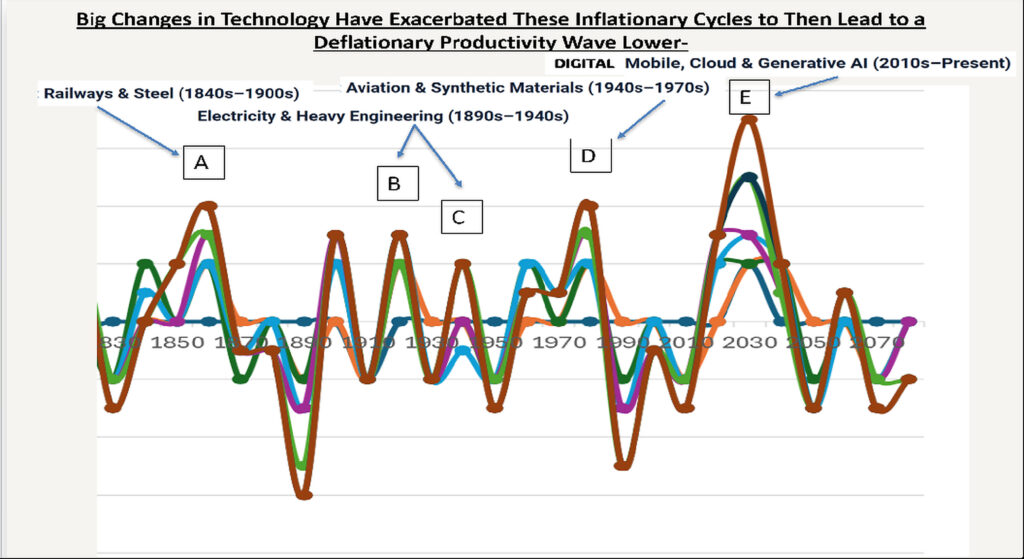
Throughout history, the world has moved through recurring periods of escalating conflict, civil unrest and economic and territorial disagreement. Our work identifies a roughly 54-year geopolitical instability cycle, separated by 27-year midcycles that can accelerate existing geopolitical trends.
These periods often share a common economic backdrop: governments have accumulated excessive debt relative to the productive capacity of their economies. When the spending and borrowing that created those financial positions begin to fracture, citizens become increasingly concerned about their economic futures and frustrated with the policies they believe contributed to the problem.
Governments often respond with additional spending, borrowing and monetary expansion. Those measures can delay the consequences for a period of time, but eventually too much money chasing limited supplies can generate significant inflation, particularly in two areas that affect virtually everyone: energy and food.
For the seed industry, that connection matters. Geopolitical instability can disrupt agricultural trade, increase input costs and push food production higher on the list of national priorities. It can also change what farmers plant, which traits they value and how urgently the industry must develop genetics capable of producing more with fewer resources.
That makes this more than a geopolitical story. It is also a seed production, breeding and food security story.
A Cycle That May Still Be Building
As economic pressure intensifies, governments sometimes look outward, blaming other countries for domestic challenges or competing more aggressively for critical resources. Countries lacking sufficient resources may increasingly focus on those that have them, creating another source of geopolitical tension.
Government debt is historically high in many parts of the world, while conflicts involving Iran and Russia-Ukraine and continuing friction among the United States, China and Taiwan demonstrate how quickly economic and territorial disagreements can escalate.
If history is any guide, these cycles tend to intensify until conditions become difficult enough that countries establish new agreements, rules of engagement and ways of managing their relationships.
Based on our historical framework, 2028 could represent a peak in the current geopolitical instability cycle. Previous turning points occurred around the end of World War I and again during the early 1970s, while important midcycle events included the end of World War II and the beginning of the war on terror following the Sept. 11, 2001, terrorist attacks.
No historical cycle perfectly repeats. But history can rhyme, and understanding those patterns can provide a framework for considering what may lie ahead.
Technology Adds Another Layer of Disruption
Another characteristic that has accompanied periods of geopolitical instability is rapid technological change.
The goal of technological advancement is generally positive: produce goods and services more efficiently, lower costs and make better use of available resources. But technological change is disruptive by nature.
It changes which jobs, skills and capabilities economies need. There is often a period when technology advances faster than people and institutions can adjust, creating economic dislocation and additional anxiety.
Artificial intelligence and the emerging potential of quantum computing represent the latest version of that shift. Both are raising questions about jobs, economic opportunity and how goods and services will be produced in the future.
Over the long term, major technological advances have generally improved productivity and economic opportunity. The transition periods, however, can be difficult. That disruption is occurring at the same time governments face high debt, inflationary pressure and costly geopolitical conflicts.
For agriculture and seed, however, the same technologies contributing to disruption elsewhere could become powerful tools for meeting the challenges ahead. Artificial intelligence has the potential to accelerate breeding, improve predictive capabilities and help companies identify useful genetics more efficiently. Future advances in computing could compress development timelines even further.
What Rising Food Prices Could Mean for Seed
Looking at roughly 1,000 years of commodity price activity, particularly wheat cash prices, our work suggests some of the greatest increases in food prices have occurred near the end of geopolitical instability cycles.
If history rhymes again, the period from now through 2028, with possible effects extending toward 2030, could bring unusually strong inflation across commodities and food.
That kind of inflation creates enormous challenges for consumers and the broader economy. Agriculture, however, operates differently when commodity prices rise. Higher prices can improve the economics of production and encourage investment in technologies that help farmers increase output.
That places the seed industry in an important position.
If farmers are being asked to produce more food amid higher costs, volatile markets and uncertain global supplies, seed becomes one of the first places agriculture can look for greater efficiency. Genetics that improve yield stability, nutrient-use efficiency, drought tolerance, disease resistance and overall productivity could become increasingly valuable.
Seed companies may also need to think differently about production capacity and the speed at which new products reach farmers. If geopolitical disruptions affect global food supplies, the industry’s ability to respond quickly becomes increasingly important.
An Opportunity for the Seed Industry
Periods of instability naturally create risk, but they also create opportunity.
Those involved in seed production, genetics and product development have an opportunity to help agriculture produce more food with greater efficiency. That carries an economic opportunity for companies, but it also has broader implications for global food security.
Unlike previous geopolitical inflationary cycles, today’s agricultural industry has access to technologies that can dramatically accelerate innovation. Artificial intelligence can help researchers analyze data, identify promising genetics and shorten parts of the development process. As computing capabilities advance, the opportunity to move useful solutions from research to farmers more quickly could become even greater.
The objective should not simply be to produce more seed. It should be to produce better solutions for an agricultural system facing tighter resources, greater volatility and increasing pressure to supply a growing global population.
Those involved in seed production, genetics and development therefore have an enormous economic, societal and humanitarian opportunity. The industry cannot control geopolitical cycles or eliminate conflict, but it can influence agriculture’s ability to respond.
The coming years may be disruptive. They may also represent one of the most important periods for seed innovation in decades. For that reason, the seed industry has good reason to remain optimistic about the road ahead.