Researchers identified a genetic stop signal that limits nitrogen uptake, opening a possible path toward crops that use fertilizer more efficiently.
Plants know when they have absorbed enough nitrogen. Scientists at New York University may have found the switch that tells them when to stop.
The discovery could eventually give plant breeders a new way to develop crops that pull more nitrogen from the soil. That could reduce fertilizer costs and limit the amount of unused nitrogen that escapes into waterways or the atmosphere.
“By identifying gene regulators that are sensitive to different levels and types of nitrogen, we uncovered a regulatory factor controlling nitrogen use and a key to improving nitrogen uptake and assimilation into organic nitrogen in plants,” said Gloria Coruzzi, the Carroll and Milton Petrie Professor in NYU’s Department of Biology and Center for Genomics and Systems Biology and the co-senior author of the study.
The research, published in The Plant Cell, centers on a protein called HHO5. Researchers found that it acts as a stop signal, telling a plant when it has enough nitrogen and can quit absorbing more from the soil.
That makes HHO5 a potential target for crop improvement.
“This knowledge may aid the engineering of ‘gluttonous’ plant varieties that absorb more available nitrogen,” said Will Hinckley, a doctoral student in NYU’s Department of Biology and the study’s lead author.
Finding the Plant’s Stop Signal
Nitrogen fertilizer has helped increase crop production, but plants absorb only about half of what farmers apply, according to the researchers.
Some of the unused nitrogen can leach into water, damage aquatic ecosystems and fuel harmful algal blooms. Nitrogen left in the soil can also contribute to emissions of nitrous oxide, a potent greenhouse gas.
Fertilizer production and transportation also carry significant costs. Supply disruptions and geopolitical instability can quickly affect prices and availability.
“Improving the efficiency of fertilizer usage would have important environmental, economic and geopolitical impacts,” Coruzzi says.
Coruzzi led the research with Mariana Obertello of the Instituto de Investigaciones en Ingeniería Genética y Biología Molecular in Buenos Aires, Argentina.
Researchers studied how plant genes respond to different amounts and forms of nitrogen. That work led them to HHO5, a regulatory protein that controls the activity of genes throughout the plant.
Plants absorb inorganic nitrogen from the soil, then convert it into organic forms they can use to grow, store nutrients and produce amino acids.
When a plant had enough organic nitrogen, HHO5 switched on genes that help the plant use the nutrient. At the same time, it shut down genes responsible for pulling more inorganic nitrogen from the soil.
The plant, in effect, felt full.
“Inorganic nitrogen is taken up by plants from soil and assimilated into organic nitrogen. This nitrogen uptake and assimilation process is heavily energy intensive. Therefore, when organic nitrogen sufficiency triggers the HHO5 gene, HHO5 in turn signals for the plant to stop absorbing additional inorganic nitrogen from soil, likely as a means of conserving energy,” Hinckley explains. “This became the model of how plants establish nitrogen satiety via HHO5.”
Plants Without HHO5 Took Up More Nitrogen
The researchers also found that HHO5 can perform two different jobs.
When HHO5 acts alone, it shuts down genes involved in nitrogen uptake. When it works with another protein called WRKY21, it activates genes that help the plant process organic nitrogen.
The team used a genomics technique called DoubleTARGET to confirm that the two proteins work together. The method allowed researchers to track how HHO5 and WRKY21 affected gene activity inside isolated plant cells.
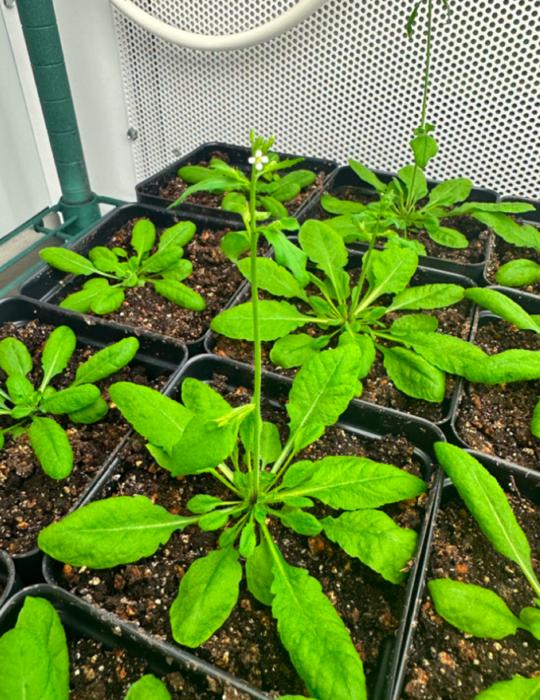
The scientists then studied Arabidopsis plants that lacked HHO5. Arabidopsis is a small flowering plant commonly used as a model in plant research.
Under specific nitrogen conditions, plants without HHO5 absorbed nearly three times more nitrogen than plants with normal HHO5 levels.
“This finding supports the idea that HHO5 signals organic nitrogen satiety and shuts down uptake of inorganic nitrogen from soil. Moreover, since removal of HHO5 improves nitrogen uptake, this indicates that modifying HHO5 has the potential to lead to tangible improvements in plant nitrogen assimilation and metabolism,” Obertello says.
A Target for Crop Breeders
The results do not yet show that removing or modifying HHO5 will improve nitrogen-use efficiency in corn, wheat, soybeans or other commercial crops.
Researchers still need to determine whether the same mechanism works across crop species. They will also need to examine whether encouraging plants to absorb more nitrogen creates tradeoffs in yield, maturity, stress tolerance, disease resistance or other important traits.
Still, the discovery gives plant scientists a specific genetic target as breeders look for crops that can produce more while making better use of fertilizer.
NYU filed a patent application covering the research and its potential use in improving plant nitrogen-use efficiency.