Canada’s seed industry is making decisions whose consequences won’t be felt for another decade. Are we giving tomorrow’s farmers a voice in those decisions?
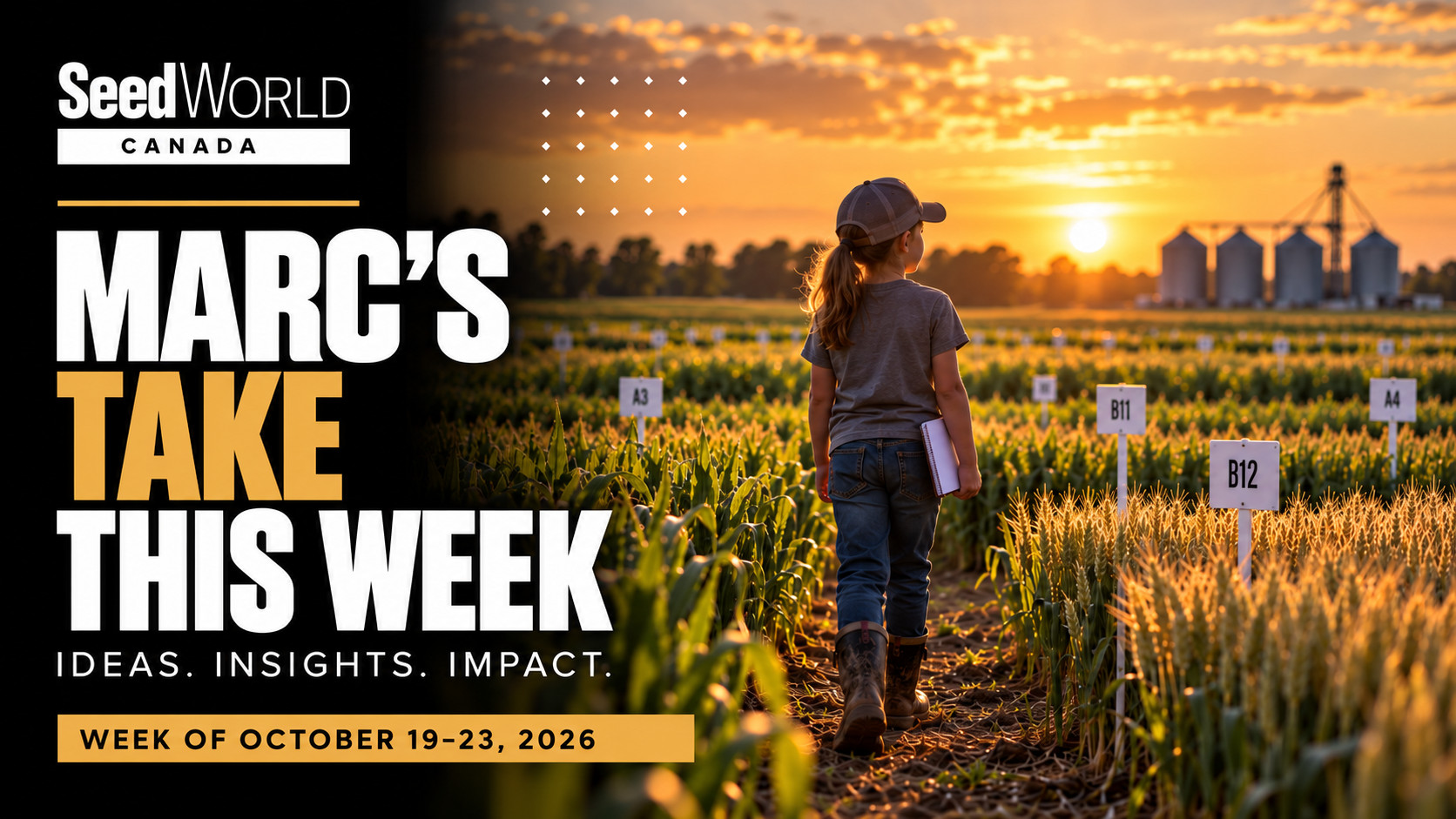
I’ve been thinking about a farmer who doesn’t exist yet.
Well, maybe they exist. They might be in high school right now, wondering whether to take over the family operation. Maybe they’re studying agriculture at university. Maybe they’re a 10-year-old riding in the combine with Dad or Grandpa.
Whoever they are, somewhere around 2040, they’ll be making decisions about which wheat, pea or soybean varieties to plant. They’ll be dealing with diseases we haven’t encountered yet, weather patterns we’re still trying to understand and markets that may look very different from today’s.
And much of what they’ll have available to grow will be determined by decisions we’re making right now. That’s what makes the current debate about Canadian plant breeding so fascinating — and a little unsettling. We keep evaluating the seed system based on what it’s delivering today, when its most important responsibility may be to people who won’t use it for another 15 years.
Consider what Canadian Wheat Research Coalition chair Jocelyn Velestuk told me in our recent feature on farmer leadership in wheat breeding. Today’s leading Canadian wheat varieties originated from crosses made between 2001 and 2009. The average journey from that initial cross to commercialization is 13 years. In other words, today’s farmers are benefiting from decisions made when flip phones were popular and Facebook was barely getting started.
It also means we can make a decision about research capacity today and potentially spend a decade congratulating ourselves on how well the system is performing before discovering what we’ve lost. That’s a particularly dangerous characteristic for an industry trying to navigate government spending reductions and changing expectations around private investment.
Politicians work on election cycles. Businesses understandably look for returns on investment. Even farmer organizations must answer to members who want to know what their checkoff dollars are accomplishing. Plant breeding operates on a different clock.
In this week’s episode of On the Brink, Jodi Souter of J4 Agri-Science describes the extraordinary financial commitment required to establish an independent breeding company when revenue could be 10 to 12 years away. I find her perspective important because it challenges an assumption I hear frequently: that if public research capacity declines, private investment will fill the gap.
Perhaps some of it will. But capital doesn’t magically appear because a government decides to spend less. Investors need a credible path to returns, and independent breeders need the financial stability to survive long enough to produce something worth selling.
That brings me to something I believe we’re not discussing nearly enough.
Who is responsible for protecting the things that won’t generate an immediate return but will make future returns possible?
Disease nurseries. Germplasm collections. Experienced research technicians. Regional testing sites. Breeder seed multiplication. Independent performance data. These aren’t always attractive investments. They don’t lend themselves to exciting announcements about breakthrough technologies. But remove enough of them and even the most talented plant breeder or best-funded startup will struggle to deliver.
That’s why I found my conversation with Ontario Seed Growers’ Association president Phil Nadalin so interesting. Nadalin works in the private sector, yet he’s deeply concerned about preserving public research capacity. He recognizes that public and private breeding aren’t necessarily competing alternatives. In many cases, they’re mutually dependent.
We need more of that thinking.
It’s also why SeCan’s upcoming 50th anniversary webinar deserves attention. SeCan was established to help move Canadian genetics into farmers’ fields. Fifty years later, its membership-driven model raises an important question: how can the seed businesses that already serve farmers help shape and finance the next generation of innovation?
There’s an opportunity here to rethink how responsibility is shared, without pretending every participant has the same incentives or resources.
And lest we think this is only about breeding, consider SGS Canada’s reflections on this year’s International Seed Testing Association meeting. Scientists are examining AI, digital imaging and new testing methods while maintaining internationally recognized standards. The interesting part isn’t simply that new technologies are emerging. It’s that the industry recognizes new methods must be validated before people can depend on them.
That’s a useful principle for the broader seed system. We can modernize it. We should modernize it. But before replacing an established process or removing an institution, we should be able to explain what function it performs, who will perform that function tomorrow and how we’ll know the replacement actually works.
Otherwise, we’re confusing change with progress.
I don’t believe we need to preserve every research station, funding arrangement or regulation indefinitely. Some things absolutely should change. There are opportunities to make the system more responsive, more efficient and more welcoming to new breeding businesses.
But I worry that we’re increasingly expecting long-term scientific infrastructure to justify itself using short-term economic logic.
A research technician who helps maintain a breeding program through a difficult funding period may contribute more to Canadian agriculture’s future than a high-profile innovation announcement. Yet it’s much easier to put a dollar figure on the announcement.
Perhaps the most important question we should ask whenever someone proposes reforming Canada’s seed system is this:
Would we still make this decision if we had to explain it to a farmer in 2040?
Not the farmer who benefits from varieties developed 15 years ago. The farmer who needs the varieties we should be developing today. Because that farmer won’t care which government balanced its budget, which organization won a policy debate or which company delivered the best quarterly results in 2026.
They’ll want to know whether we left them something worth planting. And they’ll have every right to ask.