As investment has long centered on corn and soy, one company is working row and permanent crops to explore how gene editing translates into real-world value.
For years, the commercial conversation around gene editing in agriculture has centered on the biggest acre crops. Corn and soybeans command scale, investment and attention for good reason. But that focus can also leave a lot of opportunity sitting off to the side.
Pairwise CEO Tom Adams says that is exactly where his company decided to look.
Adams says that while the science continues to evolve, Pairwise has stayed anchored to a simple goal since its founding eight years ago: making plants easier to grow and easier to eat.
That framing shifts the conversation in a way that moves gene editing away from a purely technical discussion and toward a more practical question: where does innovation actually show up in the value chain?
Start With the Plant. End With the Plate
Pairwise’s early work focused on a proof-of-concept leafy greens, specifically mustard greens that typically carry a bitter, spicy bite. By removing that spiciness through gene editing, the company created a product that could be eaten fresh rather than cooked.
“We made these leafy greens that are very high in nutrition, but typically would be bitter mustard greens,” Adams says. “One usually cooks the greens to reduce the strong flavor, but we took the spiciness out using gene editing and were able to sell fresh salad.”
The product itself mattered. But what mattered more was what it revealed about how consumers respond to innovation.
“It really proved this hypothesis we have, that tangible products give consumers a different response than they do to a survey,” Adams says. “You may still get surveys where people will be a little skeptical of technology in food. But when you give them something cool, they can see the benefit, and they tend to want to eat it.”
Having successfully demonstrated that proof-of-concept, the insight shaped how Pairwise approaches development and how it thinks about communication.
Gene Editing in Agriculture Reshapes Blackberries
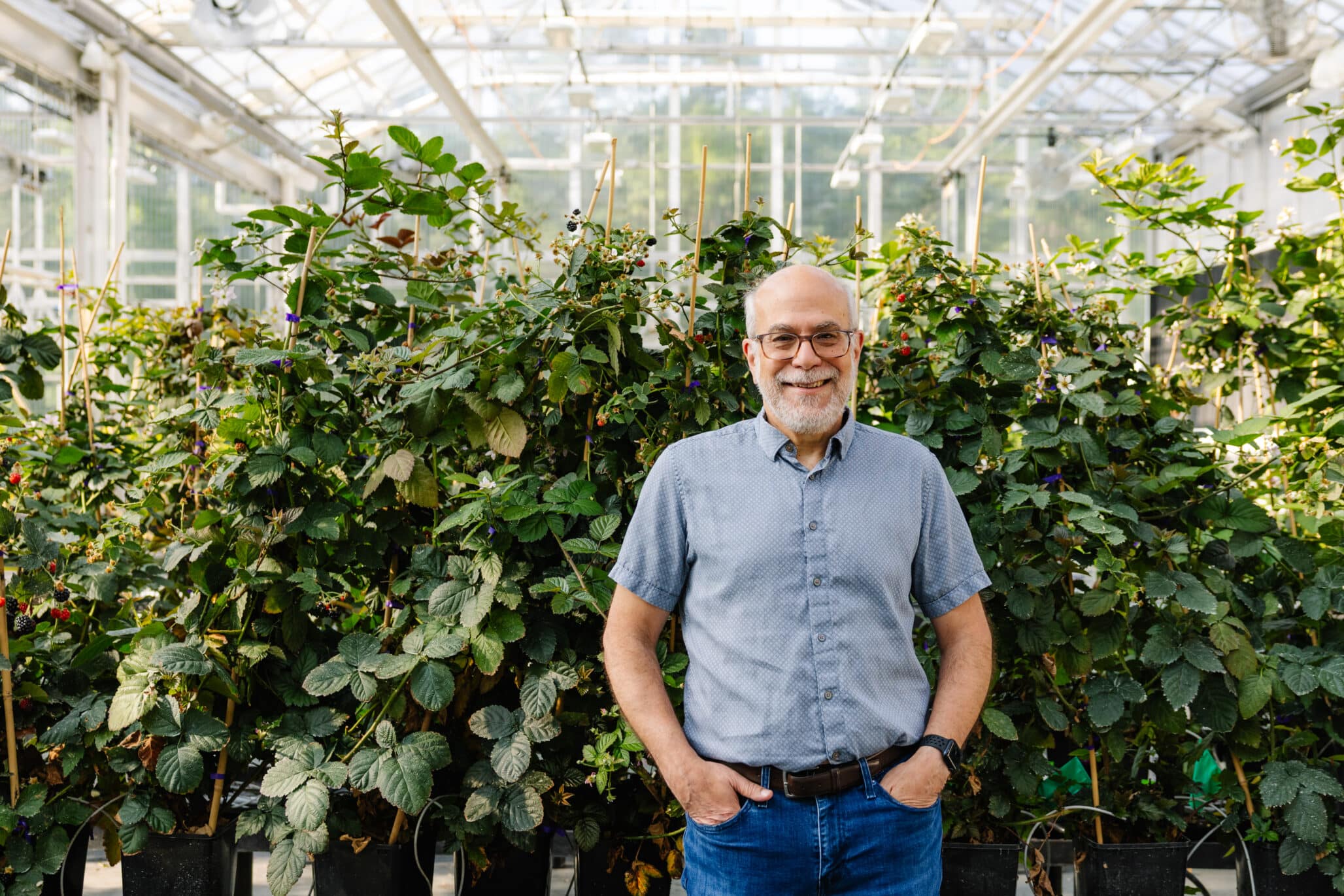
Pairwise is now working on traits in blackberry that benefit production, and traits that are appealing for consumption at the same time.
“In one generation we were created a much more compact blackberry plant that can now be grown at a density two to three times that of normally grow blackberries,” Adams says. “We’ve enabled higher productivity per acre, packing in roughly 2.5 times as many plants as a standard blackberry field.”
Traditional blackberry production comes with challenges tied to its growth habit.
“Blackberries are these brambles that get all tangled up together and have to a lot of pruning that has to be done to grow them commercially,” he says. “But we’ve made them into smaller bushes, and you can plant them more densely, and that translates into a really significant increase in yield.”
The changes extend beyond plant architecture. Higher density and more controlled growth can compress the production cycle and improve harvest efficiency.
On the consumer side, Pairwise is developing seedless blackberries, a trait aimed at improving the eating experience.
“We now have a seedless blackberry, which creates a really different eating experience,” Adams says.
The compact blackberry is already being grown and sold in Colombia, where Adams says local demand has kept much of the product in-country. The seedless version remains in earlier stages, currently in field testing.
The Gap Between Science and What People Actually Buy
The role of biotechnology in agriculture still draws strong reactions, especially in public forums. Adams does not dismiss that reality, but he argues the industry has not always helped itself in how it frames the conversation.
“I think one of the things that industry got wrong with GMOs was it tended to get into the science as opposed to the benefits,” he says.
Gene editing and GMOs are fundamentally different technologies, and Pairwise tested a different approach by putting a product directly in front of consumers. During early sampling efforts, the company distributed thousands of servings of its greens and gathered feedback in real time.
“We went to some fairs when we were launching them, and we gave them away to people and told them about the technology. “I think we gave away about 6,000 salads,” Adams says, noting that almost everyone ate the salad.
For Adams, the takeaway was simple. The industry spent years trying to win an argument about science when the more appropriate path was putting something good in front of people and letting the product speak for itself. It is a philosophy that now runs through everything Pairwise brings to market.
Pairwise’s experience suggests that the future of gene editing in agriculture may depend less on technical debates and more on creating products with benefits people can see, taste and understand
“So again, I think you lead with the benefits, and it’s about the product, not the technology,” he says. “At the same time, we believe that it’s really important to be transparent about the technology, and to share with people that technology was involved in making the product.”
Where the Next Wave of Innovation Is Hiding
For Adams, blackberry is not an endpoint. It is a starting point for a broader shift into permanent crops, where long development timelines and production risks historically have limited innovation.
“What we’ve done in blackberries, we now believe we can basically transfer that technology across a lot of the permanent crops,” he says.
That includes work in crops such as cherries, where Pairwise is exploring both consumer-facing traits and production changes. Last year, Pairwise announced a joint venture with Sun World to develop the world’s first pitless cherry.
“We’re working on cherry now to make it pitless,” Adams says. “But, we’re also turning cherry trees into bushes, so you can grow them under hoop houses anywhere in the world, rather than having to grow them in places where it doesn’t rain.”
The implications are not small. In many perennial systems, time to profitability is one of the biggest barriers to adoption.
At the same time, regulatory alignment continues to shape how quickly these innovations move. Many regions, including the European Union, are making positive progress. Adams points to differences across regions as a key factor, particularly for globally traded crops.
“The United States, Canada and many countries in South America, have all aligned on how they regulate the product, not the process,” he says. “When we look at what slowed down the big acre crops, those are all globally traded, and the slowest system tends to slow down the way that things get into commerce.”
Beyond product development, Pairwise is also working to expand access to the underlying technology through licensing. The company is making its Fulcrum® CRISPR tools available to a range of partners across agriculture. This includes Mars, Enza Zaden, Ball Horticulture, and many universities, national science institutes and global nonprofit organizations.
“The idea is that technology should not be the barrier to what we need to achieve,” Adams says. “Agriculture is huge, and there’s no reason for all of this capability to sit in one company’s hands, but to get it out as broadly as possible.”
That approach points to a broader shift in how gene editing may take shape across the industry. Not just as a tool used by a few, but as a capability that spreads across crops, regions and use cases.
For Adams, the core objective remains unchanged, even as gene editing in agriculture expands into new crops, regions and applications.
“It’s really stuck with this point of trying to make plants easier to grow and easier to eat,” he says.