Researchers Ccombine AI, 3D plant reconstruction and canopy modeling to evaluate promising corn architectures before field testing begins.
Artificial intelligence is rapidly becoming another powerful tool in the crop breeder’s toolbox. It joins decades of advances that have steadily transformed how new varieties and hybrids are developed. Modern crop breeding emerged decades ago with large plots and wide-scale phenotype selection. Over the past 20 years, genome mapping, gene editing and other new tools have enabled unprecedented achievements. Now AI is in full swing in the seed sector.
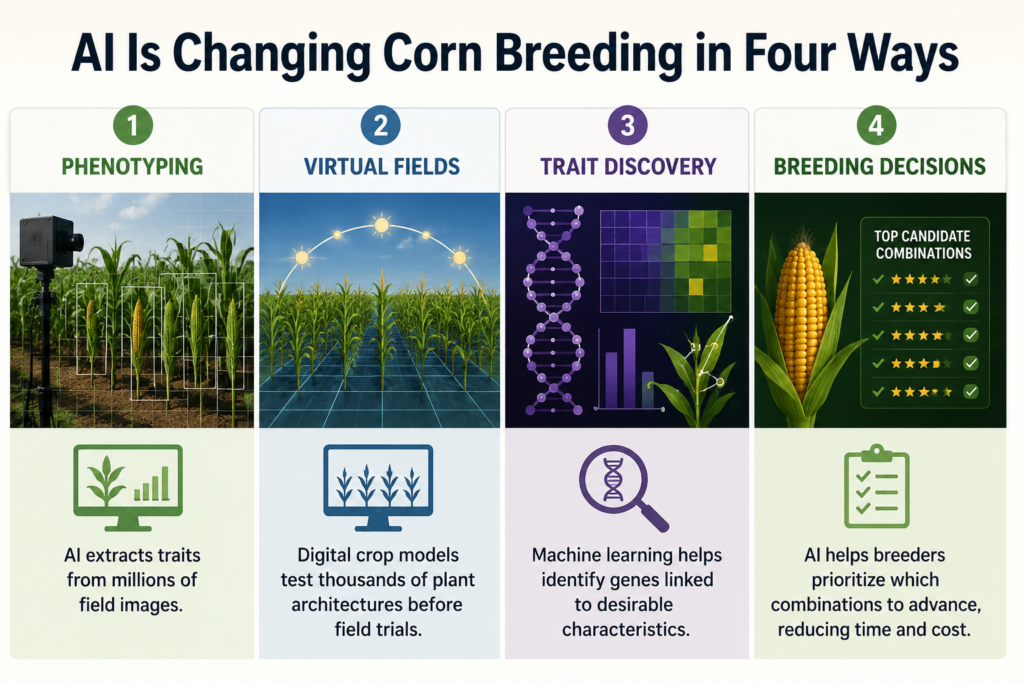
AI specializes in crunching large amounts of data. Researchers train it to extract data like recognizing specific traits in thousands of crop images from robots or drones. A recent Seed World U.S. article explored how AI accelerates phenotyping and breeding progress through image analysis.
Another emerging application is helping breeders evaluate how leaf orientation traits can support higher crop productivity. This is particularly interesting for corn, where high-density planting is the norm. Using realistic digital versions of breeding plots, or “virtual fields,” researchers test thousands of scenarios before sowing a single seed.
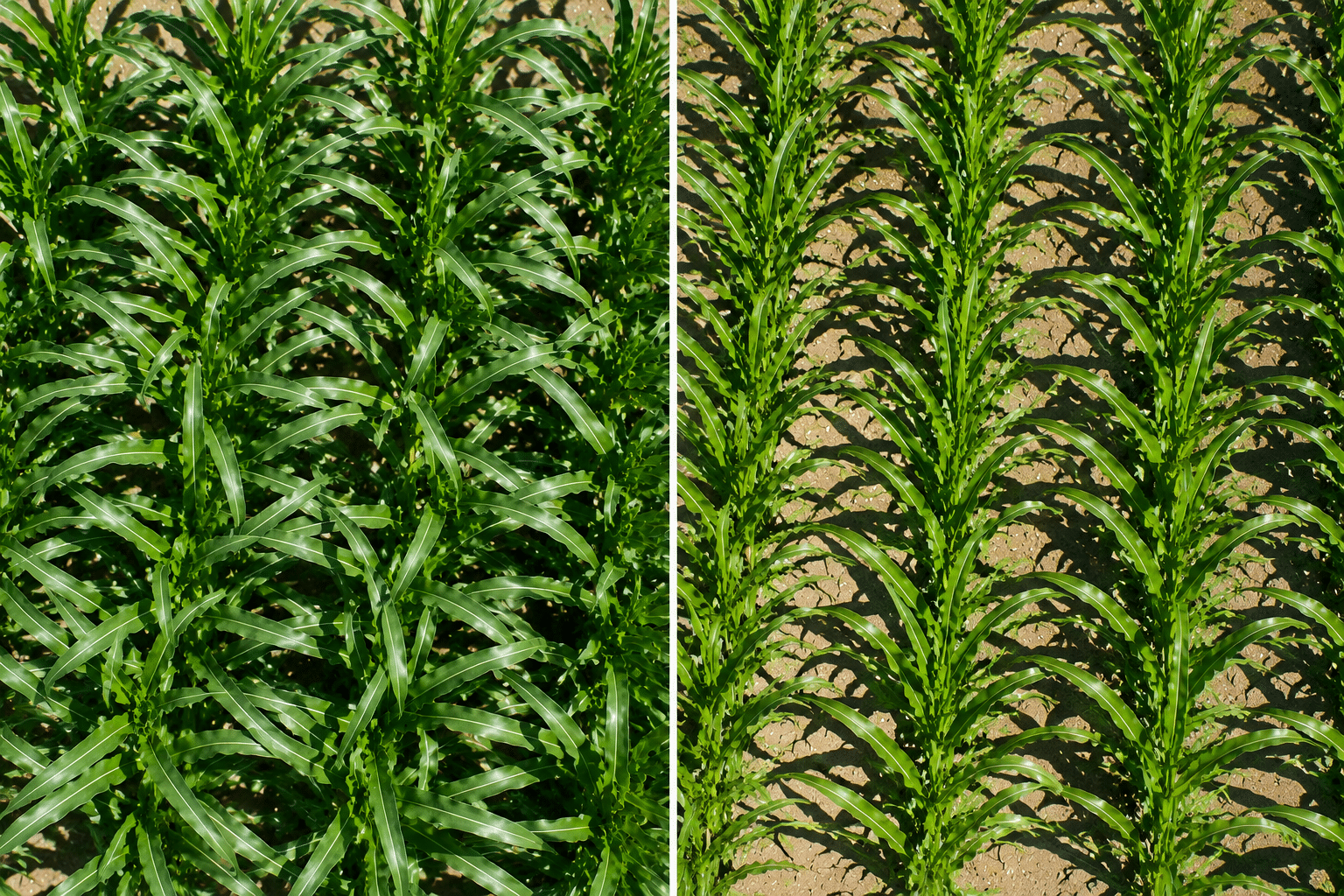
High plant density means increased shading from close-by plants. This limits light capture by individual leaves and in turn, limits overall yield potential. In response, some corn plants naturally reorient their canopies to optimize light capture (orienting leaves perpendicular to the row), a process known as canopy reorientation.
A multi-disciplinary team at Iowa State University is among a worldwide groups of scientists working to understand this adaptive response. In 2025, the team published a study describing an end-to-end AI framework. It combines realistic 3D reconstructions of field-grown corn with models that measure how effectively plant leaves absorb photosynthetically active radiation (PAR).
How Corn Reorients Its Canopy
ISU professor Yan Zhou says kernel planting determines a corn plant’s initial leaf orientation. Under the shady conditions created by high planting densities, however, some plants can reorient their canopies to capture more sunlight.
“The optimal re-orientation is off-row-parallel,” Zhou says. “A canopy of plants exhibiting this orientation does a better job of capturing the sunlight.”
To understand how canopy architecture influences light interception, researchers first needed a reliable way to measure it. Light and shade shift throughout the day. As the crop develops, traditional field measurements capture only part of the picture. The team created digital twins of corn genotypes to build and validate “virtual fields,” while using computational models to evaluate PAR.
They found that (at 30-inch row spacing) off-row-parallel leaf orientations intercepted about 22% more PAR than on-row-parallel. They also had about 14% more than random orientations. While greater PAR interception does not directly translate into an equivalent increase in yield, it identifies canopy architectures that may offer breeders additional opportunities to improve hybrid performance. They also made a detailed analysis of the impact of canopy orientations, plant and row spacings, and planting row directions on PAR interception throughout an entire typical growing season.
AI Moves From Analysis to Selection
Zhou explains the research spiked breeders’ attention because it may be possible to further improve successful hybrids without this trait.
“Towards that end we have identified about one and a half dozen genes that contribute to the re-orientation trait,” he says. “Markers for these genes could be used by breeders to add this trait to future hybrids. Alternatively, genome editing technology could be used to introduce this trait into otherwise promising inbred parents of future hybrids.”
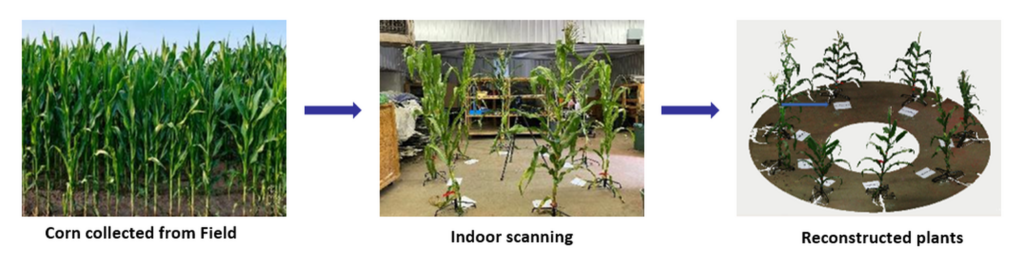
For breeders, the value lies in what comes next, says ISU Department of Mechanical Engineering professor Baskar Ganapathysubramanian. His team’s framework combines realistic 3D reconstructions with simulations to evaluate how canopy architecture influences light interception before large-scale field trials begin.
“The value for breeders,” he explains, “is that this approach can help test architectural traits, such as leaf orientation, row spacing, plant spacing, leaf angle, curvature and vertical leaf arrangement in a realistic canopy, before doing large field experiments.”
“This gives breeders more insight into which combinations of architectural traits may be promising, rather than looking at one trait at a time,” Ganapathysubramanian says.
He explains using AI to generate promising ideotypes — ideal plant architectures for breeders to target “emphasizes that AI is becoming a major force multiplier” for breeders.
“The concept of an ideotype, a target plant architecture engineered for optimal performance, goes back to C.M. Donald’s work in the late 1960s, but it has historically been very difficult to operationalize,” Ganapathysubramanian notes. “Breeders can only field-test a handful of architectural traits at a time. The combinatorial design space (leaf angle, azimuth, curvature, vertical spacing, plant and row spacing and other factors) is enormous.”
He says AI changes this picture in two ways.
First, Ganapathysubramanian says, “virtual fields and canopy simulations let us evaluate thousands of architectural combinations in silico, long before any seed goes in the ground. Second, optimization algorithms can search this design space to identify promising ideotypes, rather than evaluating one trait at a time.”
Coupled with recent advances in breeding (genomic selection, gene editing and high-throughput field phenotyping), he says this creates a tight loop. AI proposes candidate ideotypes. Breeders evaluate them and work to realize them genetically. The resulting plants generate new data that refines the next round of models.”
Ganapathysubramanian says AI will not replace field trials or breeder intuition. But, it will dramatically expand what is testable and what is targetable.
“Ideotype breeding, in particular, is finally becoming tractable because of these tools,” he says. “Not only for light interception, but potentially for many of the architectural and physiological traits that determine yield and resilience.”
Beyond Leaf Angle
The team notes that consistent superiority of the off-row parallel configuration in capturing PAR — regardless of plant spacing or row orientation — suggests that altering leaf angles may be an underused lever in breeding (and agronomic management as well) – but there are other leaf-related architectural parameters to consider.
Zhou says his team is already employing state-of-the-art phenotyping and modeling technologies to explore the impacts of leaf canopy traits.
“Using the resulting 3D canopy models, it will be possible to investigate the fraction of light captured by canopies at different times of day, on different dates and at different geographical positions across the planet,” he says. “Similarly, these 3D canopy models can be used to test the impacts of various agricultural practices, such as planting density, row and plant spacing, and row orientation on overall light capture efficiency.”
Zhou explains such information will enable breeders to make better selection decisions while also helping farmers make better agronomic decisions.
He says seed companies see successful applications in corn breeding to develop shorter hybrids with more upright leaf angle.
“It will be interesting,” he says, “to see how these new architectures perform in farmers’ fields.”