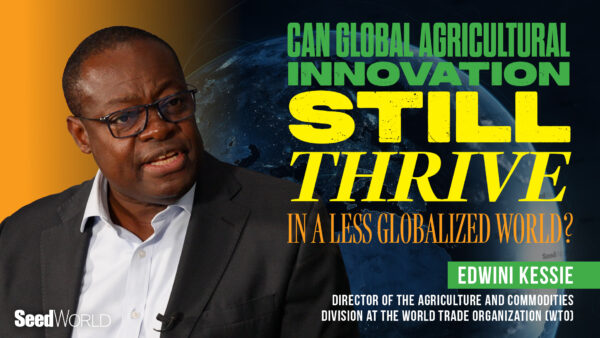
WTO agriculture leader Edwini Kessie explains why certainty, predictability and international collaboration remain essential to agricultural innovation.
For decades, the global seed sector has operated within an increasingly interconnected system of research, trade and innovation.
New varieties emerge through international collaboration. Seed moves across borders. Investment follows established rules. Farmers gain access to technologies and genetics developed around the world.
Today, that system faces growing pressure.
Rising geopolitical tensions, increasing tariffs, diverging regulations and renewed interest in national self-sufficiency are forcing agriculture to confront difficult questions. What happens to innovation when trade becomes more fragmented? Can countries strengthen food security without losing the benefits of global cooperation? And what role should the seed sector play in the conversation?
At the World Seed Congress, Seed World Group sat down with Edwini Kessie, director of the Agriculture and Commodities Division at the World Trade Organization, to discuss what is at stake.
In this interview, Kessie explains why a rules-based trading system remains critical to global agriculture, how trade fragmentation could influence investment and innovation, and why certainty and predictability matter for the future of food systems.
He also issues a call to action for seed industry leaders and national seed associations as policy decisions increasingly shape the environment in which innovation can flourish.
As governments rethink trade relationships and food security strategies, the implications for the seed sector are significant.
Watch the full interview to hear Kessie’s perspective on why maintaining global connections may be one of the most important factors in preserving agricultural innovation for future generations.